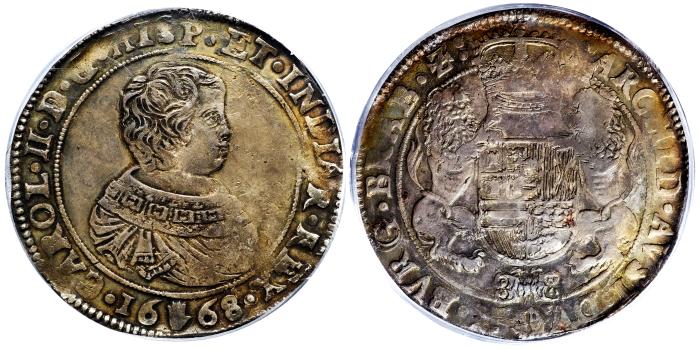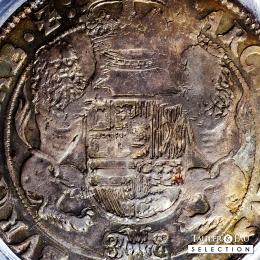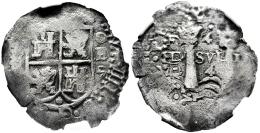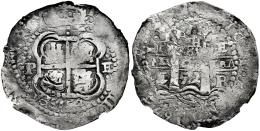
Ex Ponterio & Associates, 2004
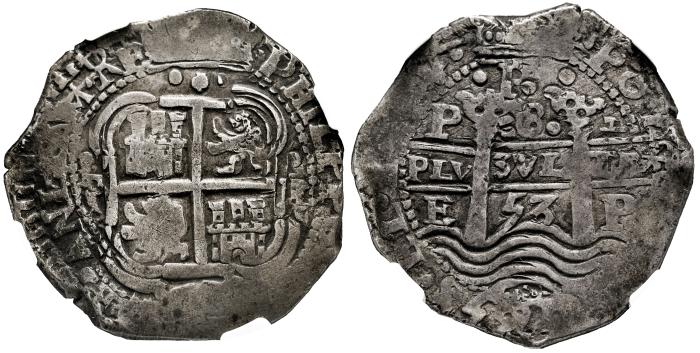
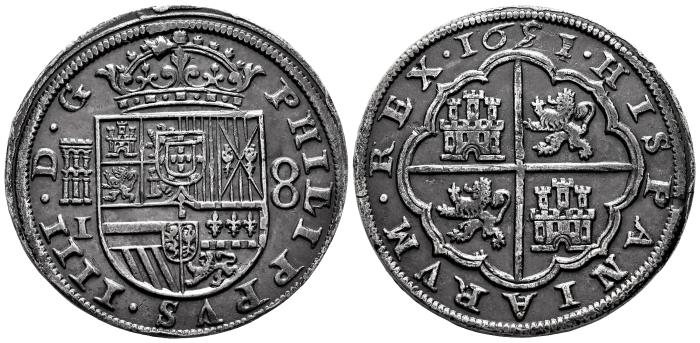
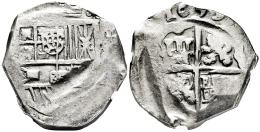
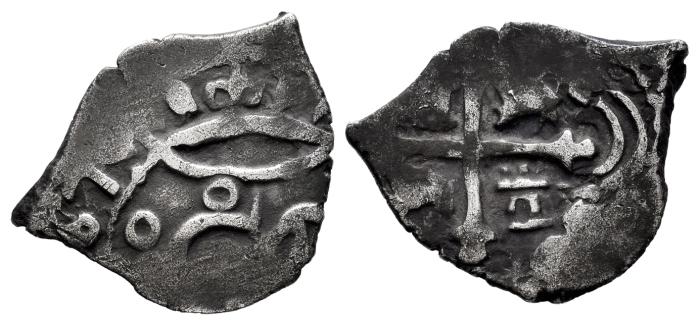
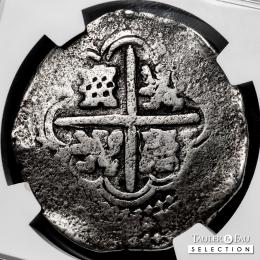
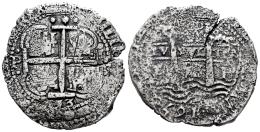
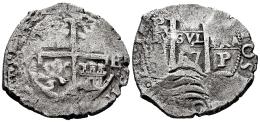
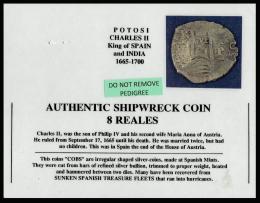
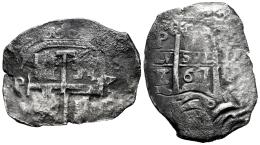
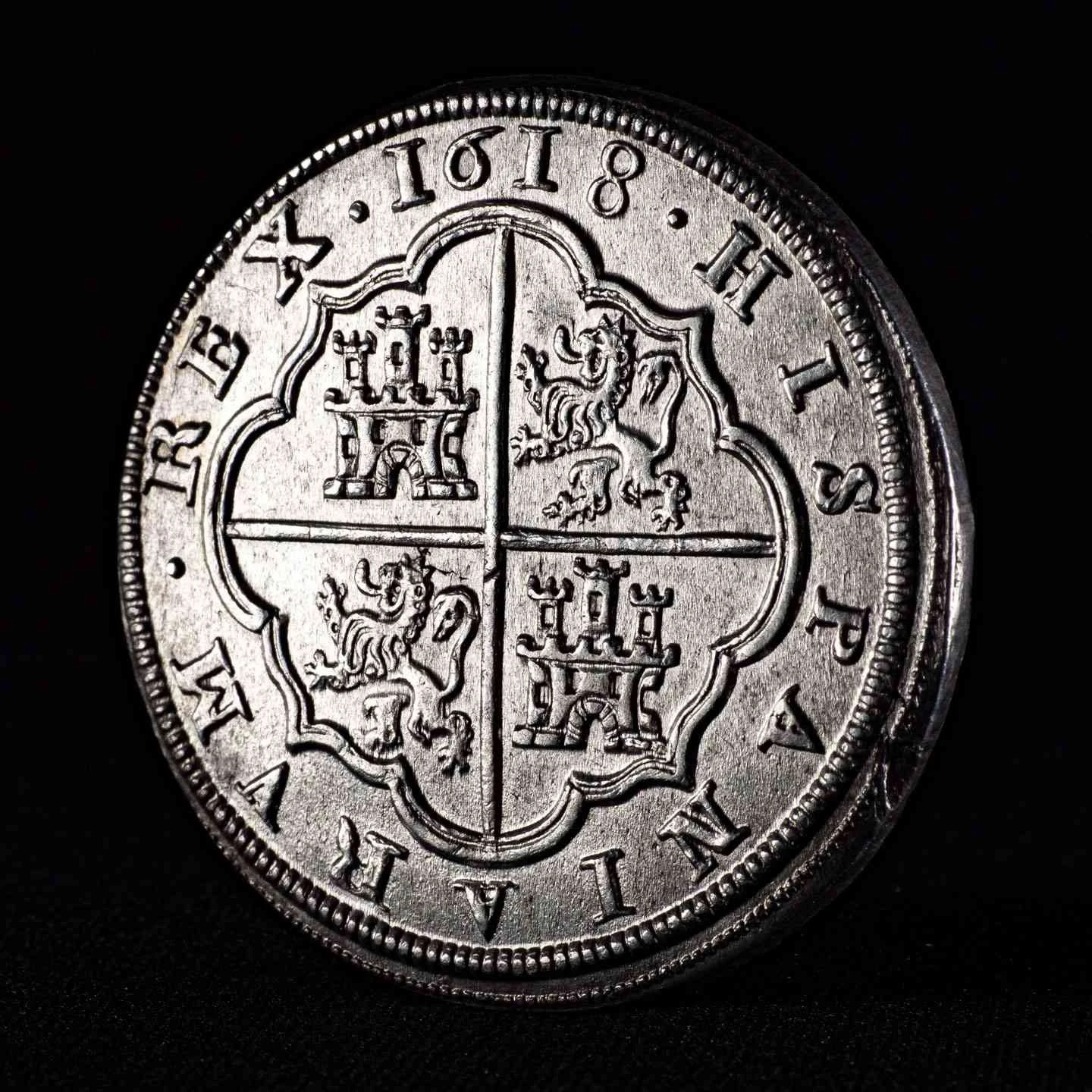
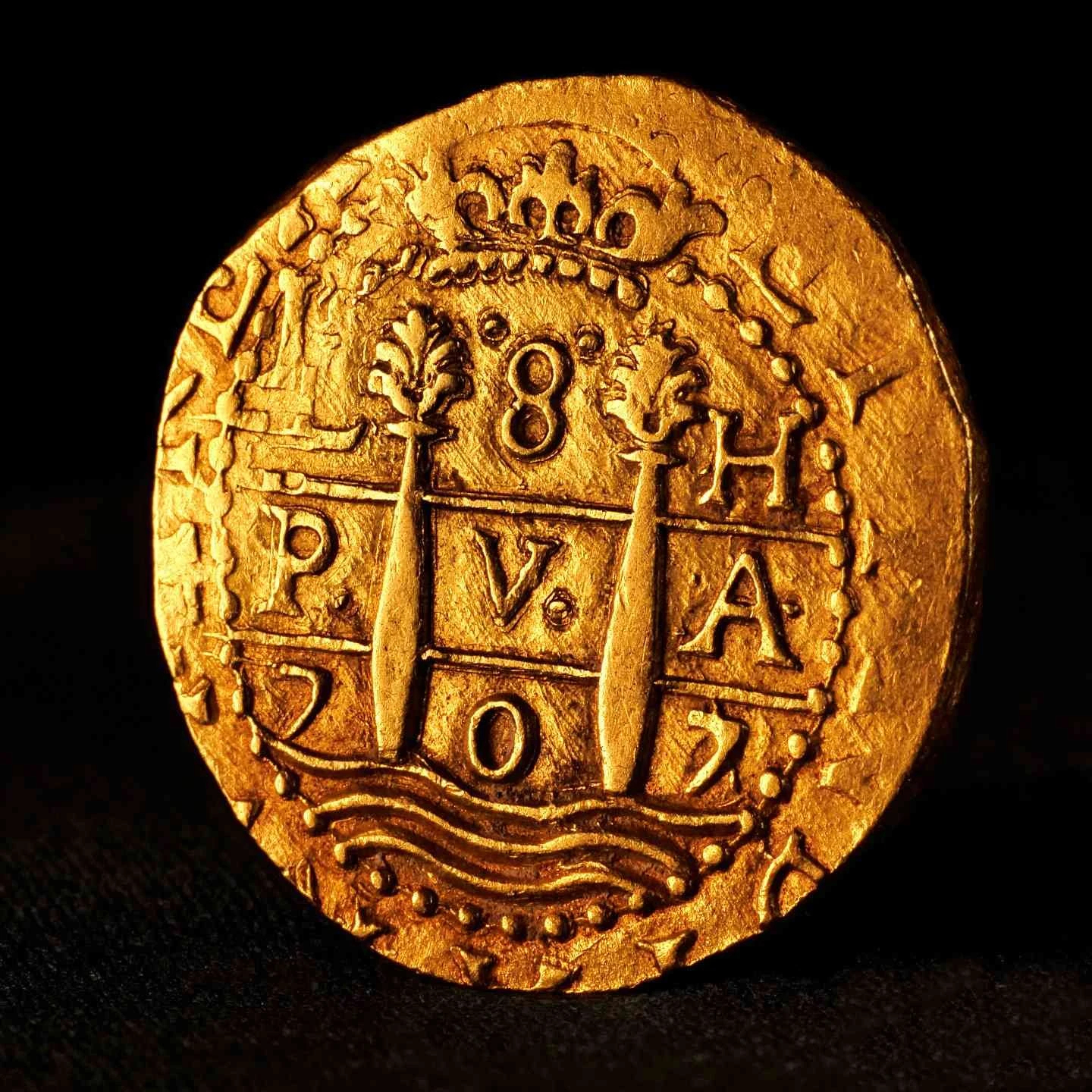
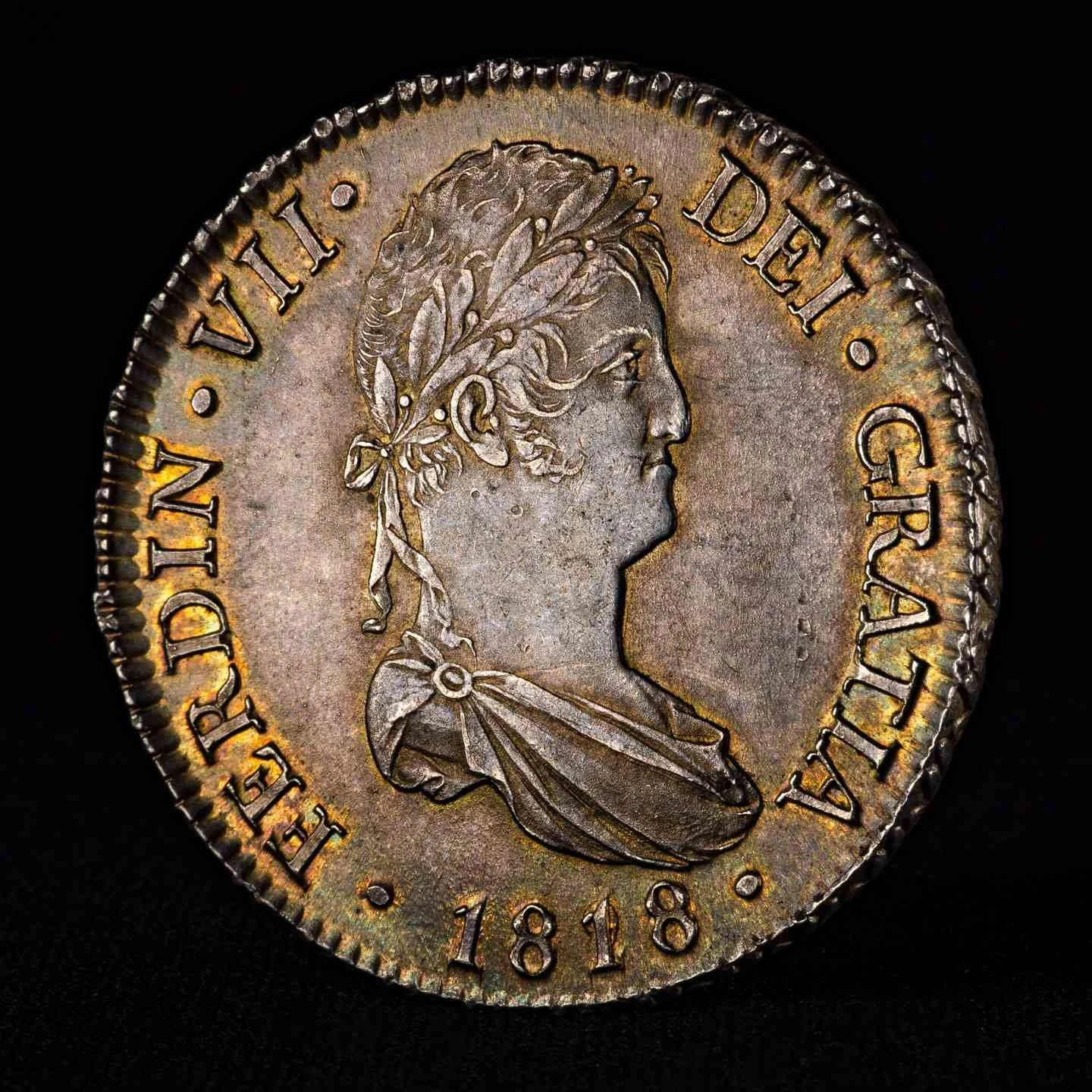
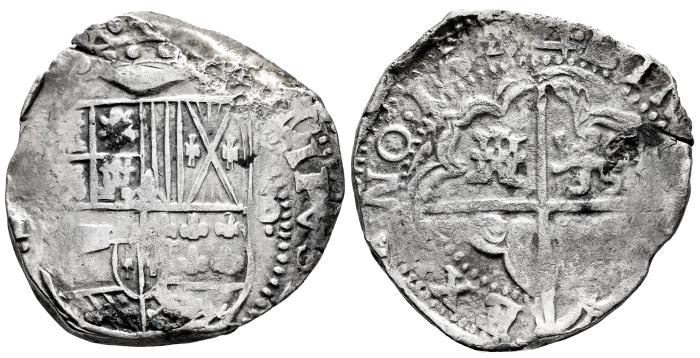
Philip IV (1621-1665). 8 reales. 1644. Potosi. (T). (Cal-1472). . 25,42 g. Fecha completa a pesar de la descuidada acuñación. Oxidación marina el el borde del anverso. Rara.
Ex Ponterio&Associates 130 (30/04/2004), lote 1588. Conserva la etiqueta de la subasta, aunque con algunos dobleces. VF. Est...700,00.
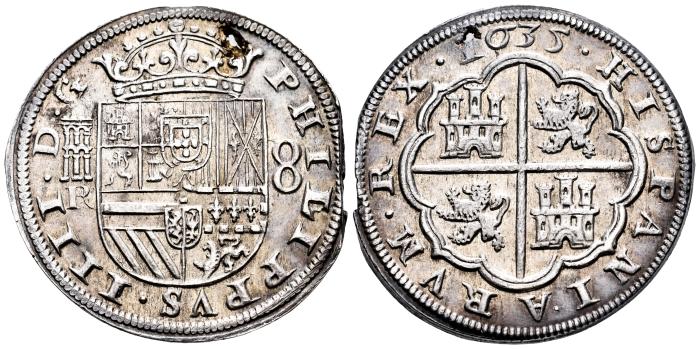
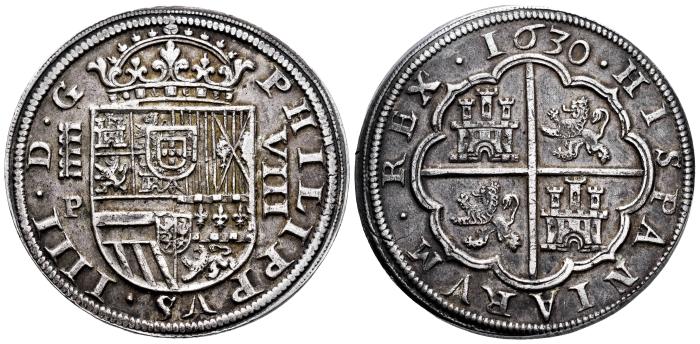
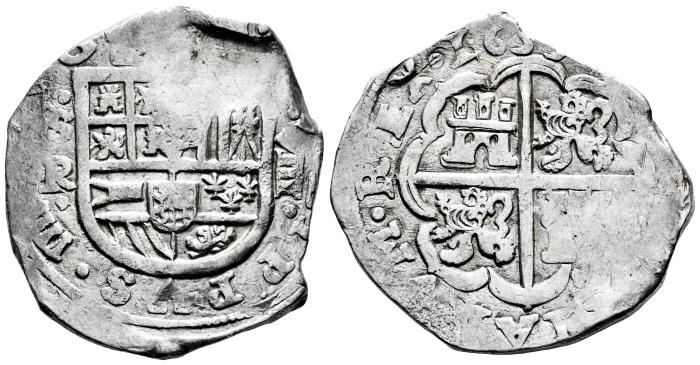
Philip IV (1621-1665). 8 reales. 1635. Segovia. R. (Cal-1606). (Jarabo-Sanahuja-C365). . 27,27 g. 8 to the right, large horizontal aqueduct and R to the left. Slight end-of-strip flaw that does not affect the design, and a striking flaw running across the planchet. Light toning. Traces of luster. XF. Est...2000,00.
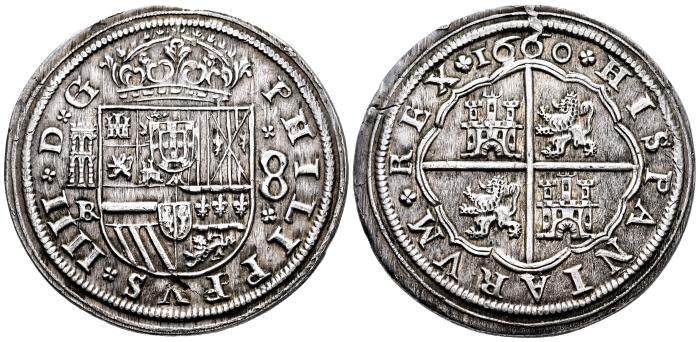
Philip IV (1621-1665). 8 reales. 1660. Segovia. BR. (Cal-1625). (Jarabo-Sanahuja-C394). . 27,19 g. Denomination 8 flanked by saltires to the right, smaller horizontal aqueduct and assayer mark to the left. Three fleurs-de-lis in Burgundy. Lovely strike on a fairly broad flan. Nice cabinet toning with traces of underlying luster. Slight flaw next to the V of PHILIPPVS. Very attractive and rare in this grade. AU. Est...3500,00.
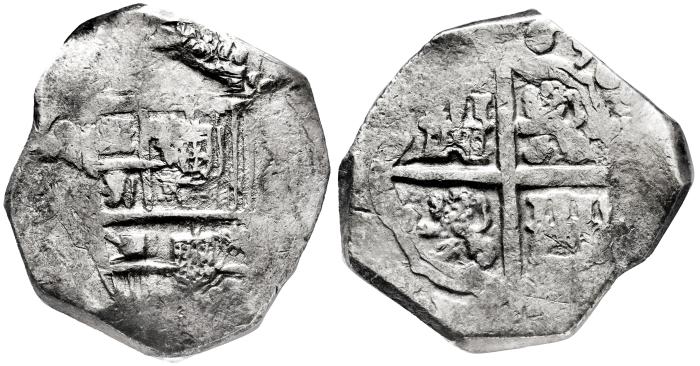
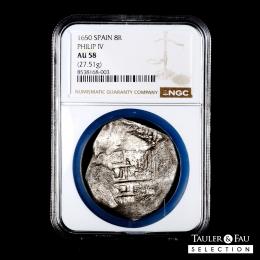
NGC - AU 58
Philip IV (1621-1665). 8 reales. 1656. Sevilla. (R). (Cal-1664). (Jarabo-Sanahuja-C527 var). . 25,42 g. Although neither the mintmark nor the assayer mark is visible, the striking style allows it to be unequivocally attributed to the Seville Mint and dated to 1656, rather than 1650, as incorrectly attributed by NGC. The mint is not specified on the certification label.
If correctly attributed to the Seville Mint and dated to 1656, it would rank as Top Pop in the NGC census. Extremely rare.
Slabbed by NGC as AU 58. Est...2000,00.
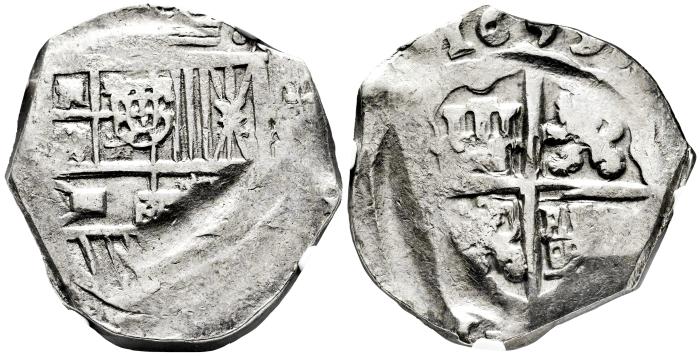
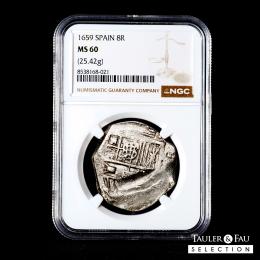
Unique? - MS 60
Philip IV (1621-1665). 8 reales. 1659. Sevilla. (R). (Cal-1667). (Jarabo-Sanahuja-C528, indicate the possible existence of this date). . 25,42 g. Full date. Although neither the mintmark nor the assayer mark is visible, the style of the strike allows it to be unequivocally attributed to the Seville Mint. Extremely rare and possibly unique. The possible existence of this date was previously noted by Jarabo-Sanahuja.
We are confident that this specimen will attract considerable interest among specialist collectors of this period.
Slabbed by NGC as MS 60. The mint is not specified on the certification label; if correctly attributed to Seville, it would be Top Pop in the NGC census. Est...2500,00.
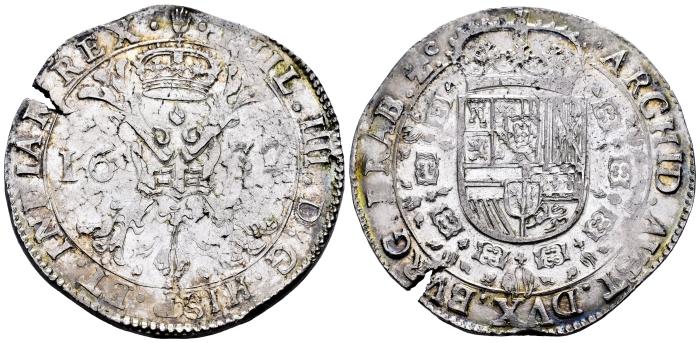
Ex Velázquez Collection
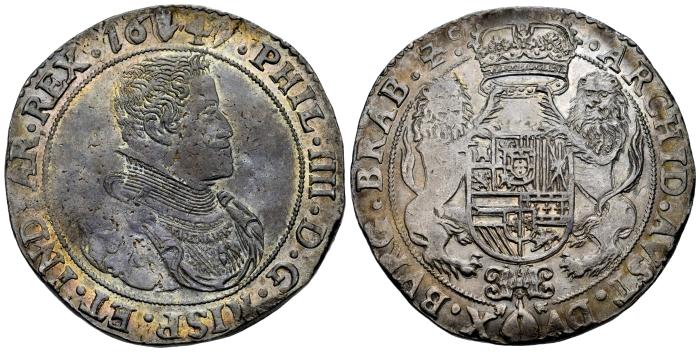
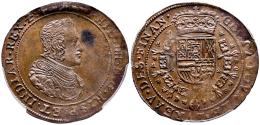
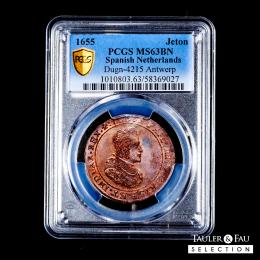
Philip IV (1621-1665). 1 patagon. 1632. Antwerpen. (Tauler-2566). (Vti-938). (Vanhoudt-645.AN). . 27,99 g. Light iridescent toning. Original luster. Rare in this grade.
Ex Velázquez Collection, Áureo & Calicó 330 (25/04/2019), lot 594. Included original label. Almost XF/XF. Est...700,00.
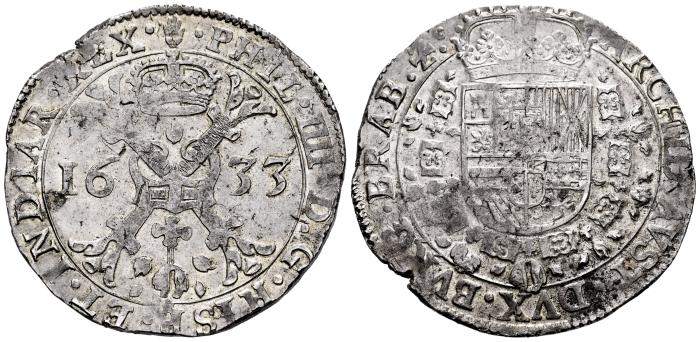
Ex Velázquez Collection
Philip IV (1621-1665). 1 patagon. 1633. Antwerpen. (Tauler-2567). (Vti-939). (Vanhoudt-645.AN). . 28,11 g. Beautiful cabinet toning with light iridescent hues. Traces of luster. Excellent eye appeal. Scarce in this grade.
Ex Velázquez Collection, Áureo & Calicó 330 (25/04/2019), lot 595. Included original label. Almost XF. Est...500,00.
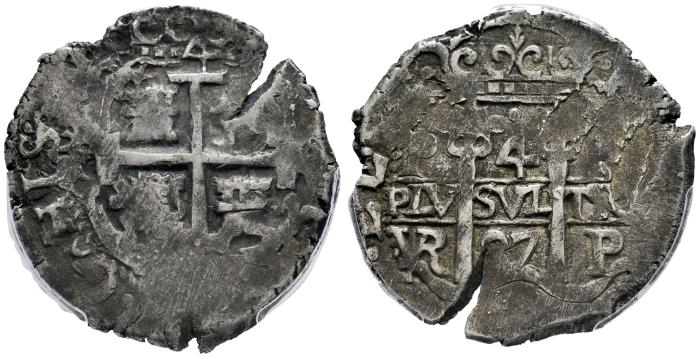
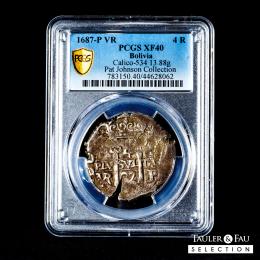
PCGS - XF 40
Charles II (1665-1700). 4 reales. 1687. Potosi. VR. (Cal-534). . 13,88 g. Very complete strike. Flan crack. Nice toning.
Slabbed by PCGS as XF 40. Only one specimen graded higher in the PCGS census.
Ex Pat Johnson Collection, as noted on the slab label.
Ex Daniel Frank Sedwick (2–3/11/2023), lot 899. Est...400,00.
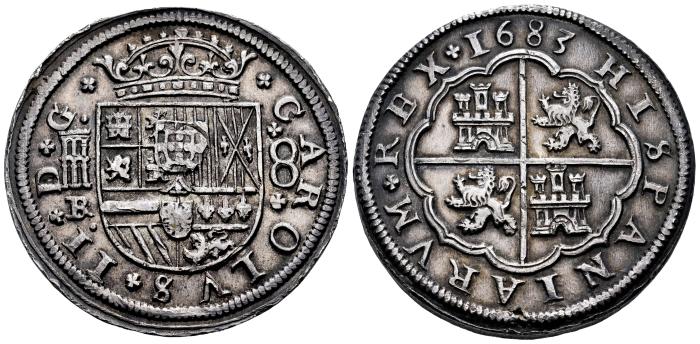
Ex Ponterio & Associates, 2004
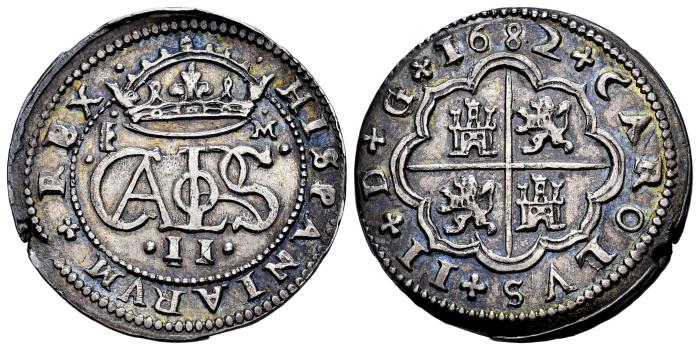
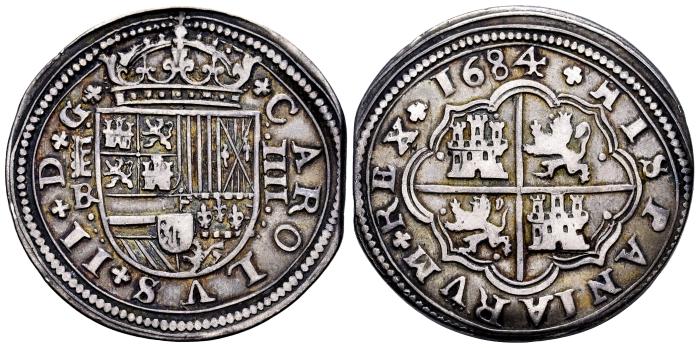
Charles II (1665-1700). 8 reales. 1683. Segovia. BR. (Cal-767). (Jarabo-Sanahuja-F19). . 27,80 g. Bars of Aragon variety. Probably struck from freshly polished dies, this magnificent uncirculated specimen ranks among the finest known. Its exceptionally sharp, well-defined reliefs stand out against attractive surfaces with lovely cabinet toning, giving it extraordinary eye appeal that is sure to captivate even the most discerning collectors.
Ex Ponterio & Associates, Auction 129 (January 2004), lot 2170. Mint state. Est...7000,00.
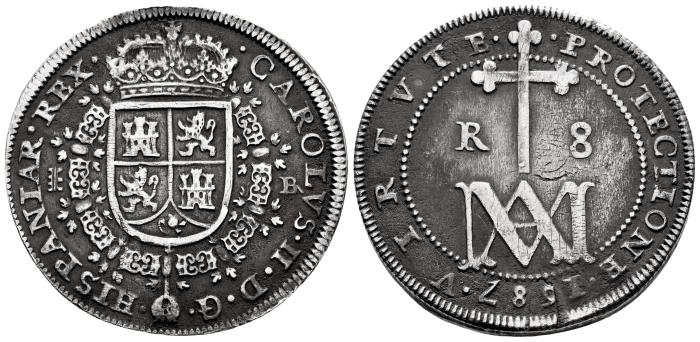
“María” type
Charles II (1665-1700). 8 reales. 1687. Segovia. BR (Bernardo Pedrera). (Cal-774). . 21,37 g. “María” type. Denomination R-8. Light toning. Rare.
First milled-struck issue of the type, introduced as a result of the devaluation established by the Pragmatic of 14 October 1686.
In order to encourage acceptance of these new pieces, which were of lower weight than the previous issues, a Marian monogram was incorporated on the reverse, accompanied by a stylized cross, the denomination at both sides, and the motto Virtute Protectione. Almost XF. Est...2500,00.
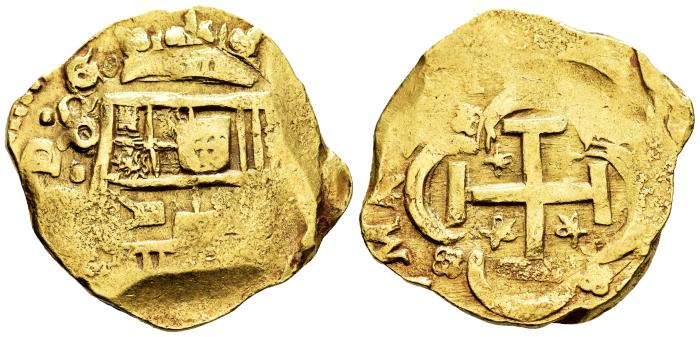
NGC - AU 55
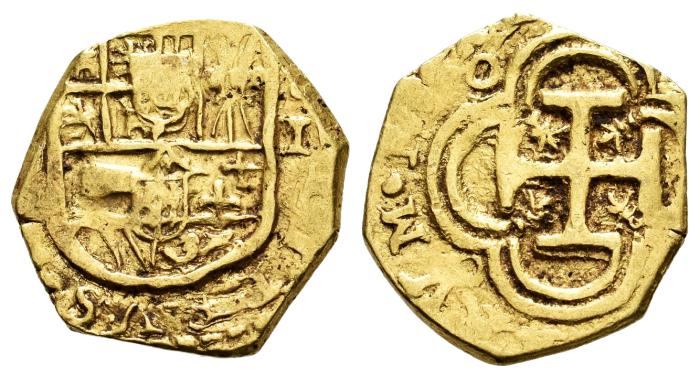
Charles II (1665-1700). 8 escudos. (1670-1699). Sevilla. (Cal-Tipo 181). (Cal onza-175, similar). (Tauler-175, similar). . 26,74 g. Carelessly struck, as usual. Date not visible. Assayer mark S or G presumed below the mintmark. With the Portugal escutcheon. Small fleurs-de-lis in the angles of the cross and four-petaled rosettes in the lobed angles. Much of the shield visible, with complete crown and cross. Nice color. Very rare.
Slabbed by NGC as AU 55 . Est...12000,00.
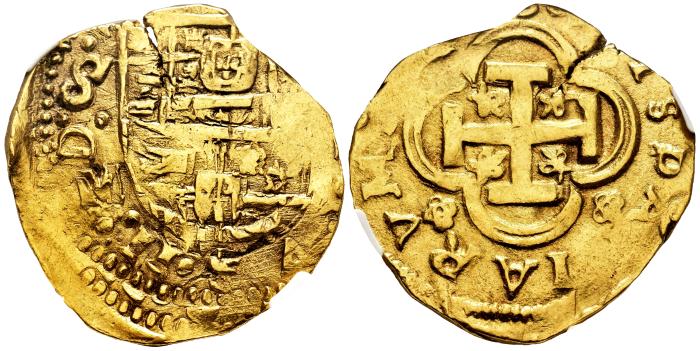
NGC - AU 50
Charles II (1665-1700). 8 escudos. (1666-69). Sevilla. (M). (Cal-Tipo 181). (Tauler-159a similar). . 26,79 g. Date not visible. With the Portugal escutcheon. Rosettes in the lobed corners of the reverse border. Part of the king's name and regnal number visible.
Characteristically crude issue which, judging by its style, would appear to belong to a later period of the series. Broad flan and nice color. Very rare in any grade. br>
Slabbed by NGC as AU 55. Est...18000,00.
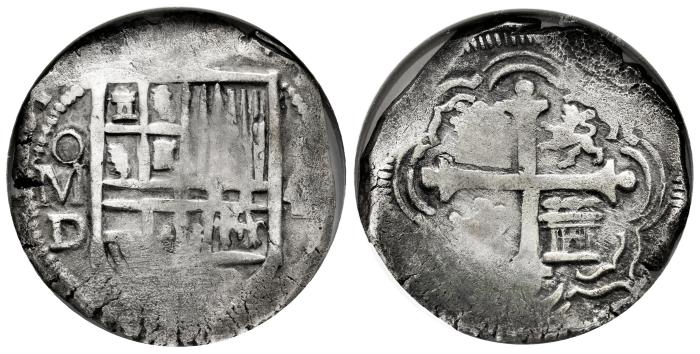
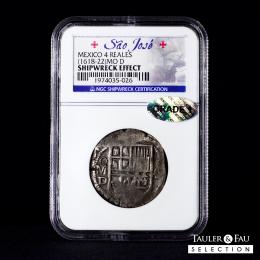
São José - NGC
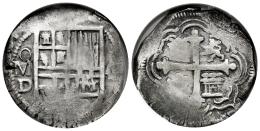
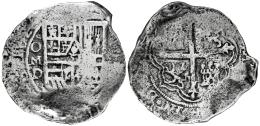
Shipwreck coins. Philip III (1598-1621). 4 reales. (1620-1622). Mexico. D. . Date not visible. Recovered from the wreck of the São José, which sank off the coast of Mozambique in 1622.
Slabbed by NGC with the Shipwreck Effect designation. Special "Shipwreck Certification" label.
The São José was a Portuguese vessel that set sail from Lisbon to India in 1622, carrying passengers, merchandise and a valuable cargo of silver coins.
At that time, Portugal and Spain were united under the same monarch, Philip IV, and maintained important trade routes to the East. However, these routes were constantly threatened by English and Dutch forces seeking to challenge their control over trade in the Indian Ocean.
On July 24, 1622, while sailing off the coast of Mozambique, the São José became involved in a naval engagement with English and Dutch vessels. During the battle, the ship ran aground on a reef and eventually sank, taking much of its valuable cargo to the seabed.
The wreck remained submerged for nearly four centuries until its discovery in 2004. Subsequent archaeological investigations led to the recovery of thousands of Spanish silver coins, primarily 8-real and 4-real pieces minted during the reigns of Philip II and Philip III, along with cannons, anchors and other artifacts belonging to the vessel.
The discovery of the São José represents an important historical find, providing valuable insights into navigation, maritime trade and the economic and cultural connections between Europe, Africa and Asia during the 17th century. Est...600,00.
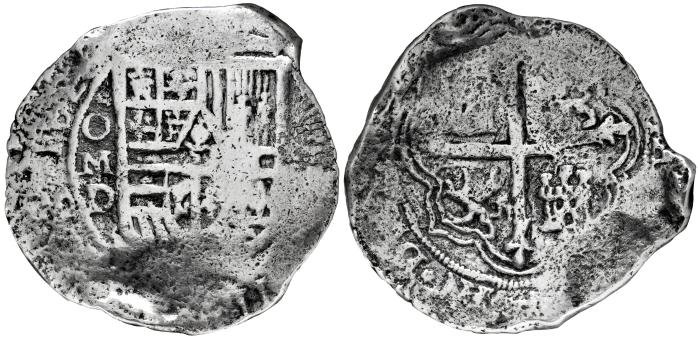
Spice Islands - NGC
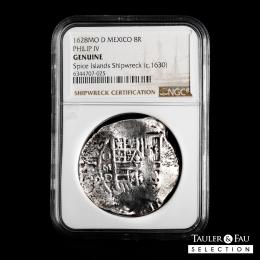
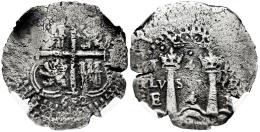
Shipwreck coins. Philip IV (1621-1665). 8 reales. 1628. Mexico. (D). (Cal-1312). . Recovered from the Spice Islands Shipwreck. Slabbed by NGC as Genuine. Special label "Shipwreck Certification".
In circa 1630, an unidentified vessel sunk in the waters off Southeast Asia. Its exact primary purpose was unknown but it yielded a treasure trove of silver coins, predominantly Spanish in origin.
The recovered coins, identified by experts through mint marks and die studies, represent the active trade in the Spice Islands during the early 18th century. Est...600,00.
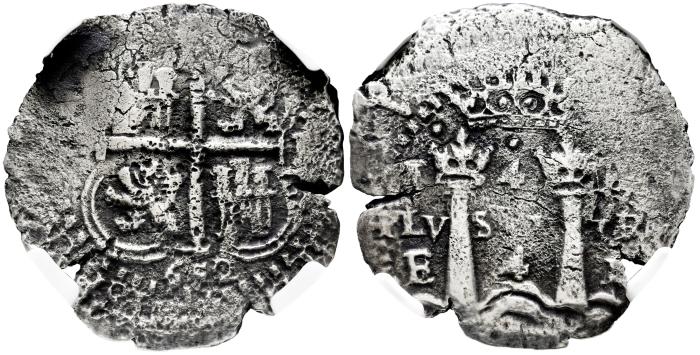
Capitana - VF Details
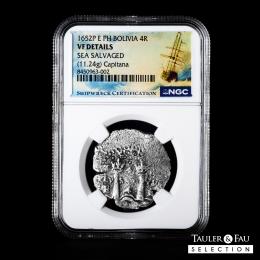
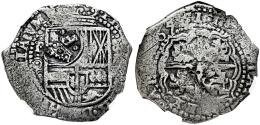
Shipwreck coins. Philip IV (1621-1665). 4 reales. 1652. Potosi. E. (Cal-1111). . 11,24 g. Transitional type. Complete and very bold pillars, nearly complete cross with clear date below. Light surface corrosion, contrasting toning, and small edge crack. Rare.
Recovered from the wreck of “La Capitana”, sunk in 1654 off Chanduy, Ecuador.
Slabbed by NGC as VF Details, Sea Salvaged. Special “Shipwreck Blue Label”.
The Jesús María de la Limpia Concepción was the capitana of the South Sea Fleet in 1654, and her wreck represented the greatest loss suffered by the Spanish Pacific fleet. Official records reported the loss of 3 million pesos in silver —2,212 ingots, 216 chests of coins, and 22 boxes of wrought silver—, although, including contraband and private consignments, the total may have reached as much as 10 million pesos.
The ship, clearly overloaded, ran onto the reefs south of Punta Santa Elena as a result of pilot error. Twenty people died. During the following eight years, Spanish salvagers officially recovered more than 3 million pesos in coins and bullion, although probably much more was recovered off the record. The main person responsible for these operations was Bernardo de Campos, the ship’s own silvermaster and, paradoxically, one of those responsible for overloading her with contraband.
The wreck was rediscovered in the mid-1990s and salvaged in 1997. Following the split with the Ecuadorian government in 1998, much of the more than 5,000 coins recovered was sold at auction in 1999. The group consisted almost exclusively of Potosí 8 and 4 reales, including countermarked issues of 1649-1652, transitional issues of 1652, and post-transitional pillars-and-waves cobs of 1653-1654, many of them in excellent condition and carefully conserved. Est...700,00.
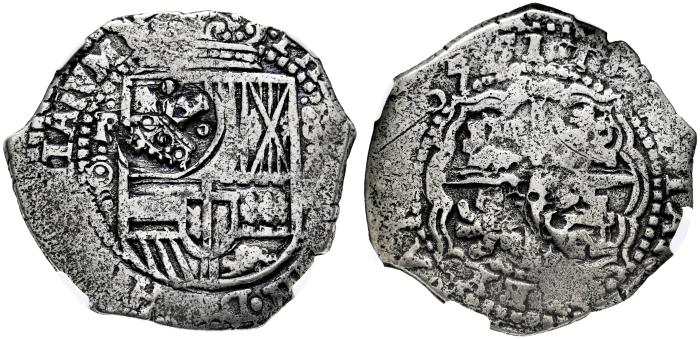
Capitana - VF Details
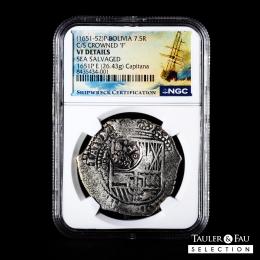
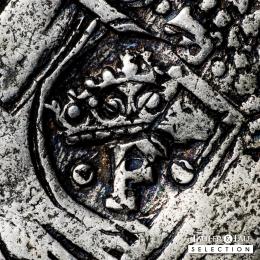
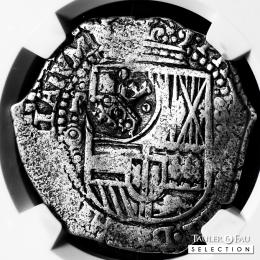
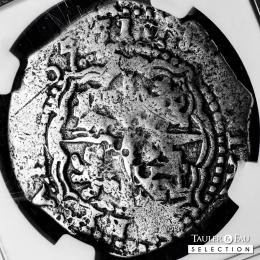
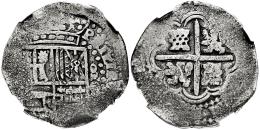
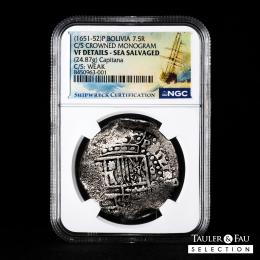
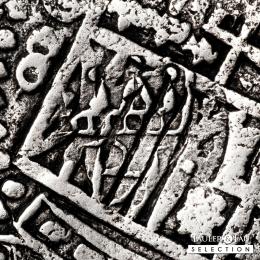
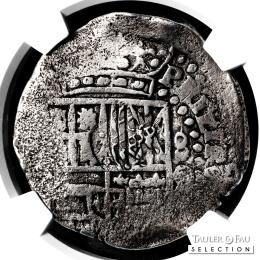
Shipwreck coins. Philip IV (1621-1665). 8 reales. 1651. Potosi. O. (Cal-1489). . 26,43 g. ·F· countermark below crown well struck on the obverse, authorizing its circulation at a value of 7 1/2 reales.
Recovered from the wreck of “La Capitana”, sunk in 1654 off Chanduy, Ecuador.
Slabbed by NGC as VF Details, Sea Salvaged. Special “Shipwreck Blue Label”.
The Jesús María de la Limpia Concepción was the capitana of the South Sea Fleet in 1654, and her wreck represented the greatest loss suffered by the Spanish Pacific fleet. Official records reported the loss of 3 million pesos in silver —2,212 ingots, 216 chests of coins, and 22 boxes of wrought silver—, although, including contraband and private consignments, the total may have reached as much as 10 million pesos.
The ship, clearly overloaded, ran onto the reefs south of Punta Santa Elena as a result of pilot error. Twenty people died. During the following eight years, Spanish salvagers officially recovered more than 3 million pesos in coins and bullion, although probably much more was recovered off the record. The main person responsible for these operations was Bernardo de Campos, the ship’s own silvermaster and, paradoxically, one of those responsible for overloading her with contraband.
The wreck was rediscovered in the mid-1990s and salvaged in 1997. Following the split with the Ecuadorian government in 1998, much of the more than 5,000 coins recovered was sold at auction in 1999. The group consisted almost exclusively of Potosí 8 and 4 reales, including countermarked issues of 1649-1652, transitional issues of 1652, and post-transitional pillars-and-waves cobs of 1653-1654, many of them in excellent condition and carefully conserved. Est...1500,00.
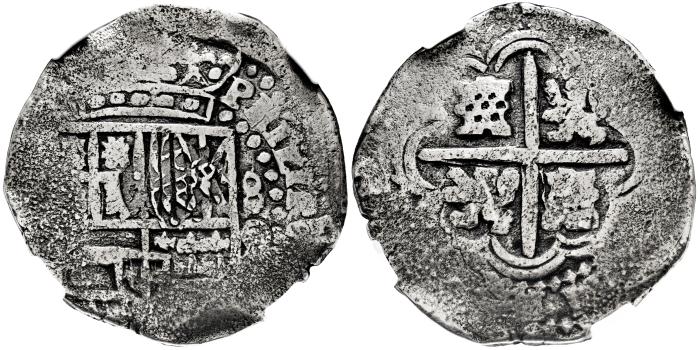
Capitana - VF Details
Shipwreck coins. Philip IV (1621-1665). 8 reales. (1651-1652). Potosi. O. (Cal-Tipo 327). . 24,87 g. PH countermark below crown well struck on the obverse, authorizing its circulation at a value of 7 1/2 reales.
Recovered from the wreck of “La Capitana”, sunk in 1654 off Chanduy, Ecuador.
Slabbed by NGC as VF Details, Sea Salvaged. Special “Shipwreck Blue Label”.
The Jesús María de la Limpia Concepción was the capitana of the South Sea Fleet in 1654, and her wreck represented the greatest loss suffered by the Spanish Pacific fleet. Official records reported the loss of 3 million pesos in silver —2,212 ingots, 216 chests of coins, and 22 boxes of wrought silver—, although, including contraband and private consignments, the total may have reached as much as 10 million pesos.
The ship, clearly overloaded, ran onto the reefs south of Punta Santa Elena as a result of pilot error. Twenty people died. During the following eight years, Spanish salvagers officially recovered more than 3 million pesos in coins and bullion, although probably much more was recovered off the record. The main person responsible for these operations was Bernardo de Campos, the ship’s own silvermaster and, paradoxically, one of those responsible for overloading her with contraband.
The wreck was rediscovered in the mid-1990s and salvaged in 1997. Following the split with the Ecuadorian government in 1998, much of the more than 5,000 coins recovered was sold at auction in 1999. The group consisted almost exclusively of Potosí 8 and 4 reales, including countermarked issues of 1649-1652, transitional issues of 1652, and post-transitional pillars-and-waves cobs of 1653-1654, many of them in excellent condition and carefully conserved. Est...1500,00.
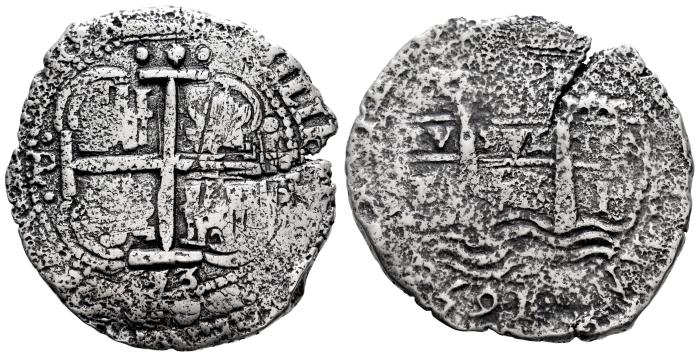
Capitana
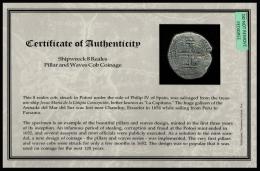
Shipwreck coins. Philip IV (1621-1665). 8 reales. 1653. Potosi. E. (Cal-1503). . 22,12 g. PH below the crown on the reverse. Triple date, two of them partial. Flan crack. Saltwater damage. From the wreck of “La Capitana”, sunk in 1654 off Chanduy, Ecuador. With photo-certificate of authenticity.
The Jesús María de la Limpia Concepción was the capitana of the South Sea Fleet in 1654, and her wreck represented the greatest loss suffered by the Spanish Pacific fleet. Official records reported the loss of 3 million pesos in silver —2,212 ingots, 216 chests of coins, and 22 boxes of wrought silver—, although, including contraband and private consignments, the total may have reached as much as 10 million pesos.
The ship, clearly overloaded, ran onto the reefs south of Punta Santa Elena as a result of pilot error. Twenty people died. During the following eight years, Spanish salvagers officially recovered more than 3 million pesos in coins and bullion, although probably much more was recovered off the record. The main person responsible for these operations was Bernardo de Campos, the ship’s own silvermaster and, paradoxically, one of those responsible for overloading her with contraband.
The wreck was rediscovered in the mid-1990s and salvaged in 1997. Following the split with the Ecuadorian government in 1998, much of the more than 5,000 coins recovered was sold at auction in 1999. The group consisted almost exclusively of Potosí 8 and 4 reales, including countermarked issues of 1649-1652, transitional issues of 1652, and post-transitional pillars-and-waves cobs of 1653-1654, many of them in excellent condition and carefully conserved. Choice F. Est...450,00.
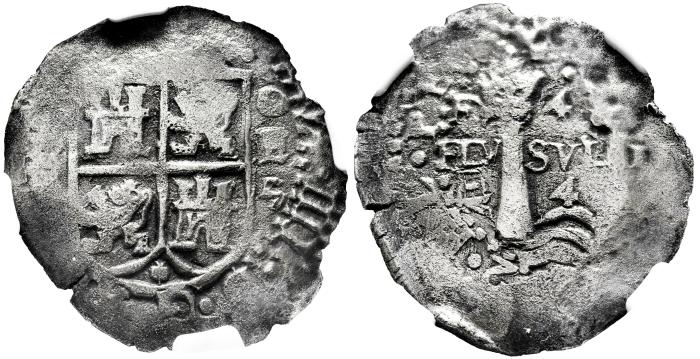
Maravillas - NGC
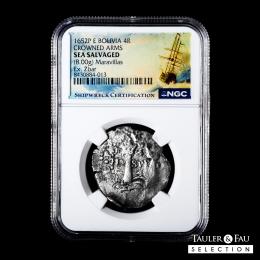
Shipwreck coins. Philip IV (1621-1665). 4 reales. 1652. Potosi. E. (Cal-1109). . 8,00 g. Transitional type. Saltwater damage. Rare.
Recovered from the wreck of the Maravillas, sunk in 1656 off Grand Bahama Island, Bahamas.
Slabbed by NGC as Sea Salvaged. Special “Shipwreck Blue Label”.
Ex Zbar Collection.
The Nuestra Señora de las Maravillas was the flagship (almiranta) of a Spanish fleet returning to Spain and sank in 1656 near Grand Bahama Island. It officially carried more than five million pesos in treasure, mainly silver, along with the usual contraband transported on such voyages. Part of this wealth came from silver salvaged from another shipwreck of the South Seas Fleet in 1654.
The disaster occurred when the ship unexpectedly ran into shallow water and was then struck by another vessel of the fleet. The captain attempted to beach the ship on a nearby reef, but the chaos and strong nighttime winds led to the loss of the vessel and the scattering of its remains.
Spanish salvagers soon recovered about half a million pesos, and additional recoveries continued for decades, although more than half of the official cargo remains missing. In the twentieth century the wreck was rediscovered by treasure hunters beginning in 1972, whose finds included Mexican, Potosí, and Cartagena silver cobs, as well as some gold coins from Bogotá. The site is still being explored today, and it is possible that a large portion of the treasure remains undiscovered. Est...700,00.
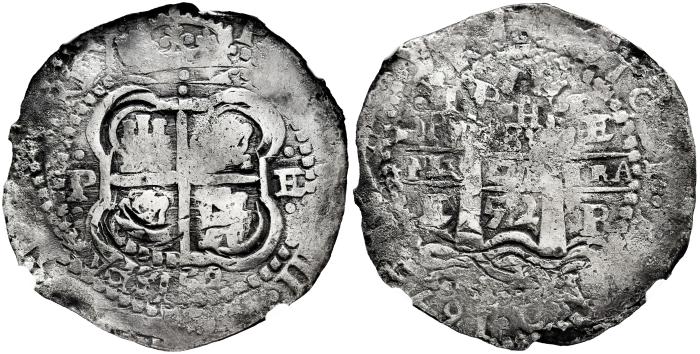
Maravillas - VF Details
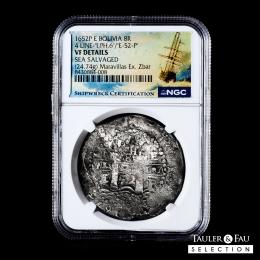
Shipwreck coins. Philip IV (1621-1665). 8 reales. 1652. Potosi. E. (Cal-1500). . 24,74 g. Transitional type. IPH6 below the crown on the reverse. Light double strike. Broad and round flan, with complete cross and complete pillars and waves, though the overall details are weaker due to flat areas and surface corrosion. Rare.
Recovered from the wreck of the Maravillas, sunk in 1656 off Grand Bahama Island, Bahamas.
Slabbed by NGC as VF Details, Sea Salvaged. Special “Shipwreck Blue Label”.
Ex Zbar Collection.
The Nuestra Señora de las Maravillas was the flagship (almiranta) of a Spanish fleet returning to Spain and sank in 1656 near Grand Bahama Island. It officially carried more than five million pesos in treasure, mainly silver, along with the usual contraband transported on such voyages. Part of this wealth came from silver salvaged from another shipwreck of the South Seas Fleet in 1654.
The disaster occurred when the ship unexpectedly ran into shallow water and was then struck by another vessel of the fleet. The captain attempted to beach the ship on a nearby reef, but the chaos and strong nighttime winds led to the loss of the vessel and the scattering of its remains.
Spanish salvagers soon recovered about half a million pesos, and additional recoveries continued for decades, although more than half of the official cargo remains missing. In the twentieth century the wreck was rediscovered by treasure hunters beginning in 1972, whose finds included Mexican, Potosí, and Cartagena silver cobs, as well as some gold coins from Bogotá. The site is still being explored today, and it is possible that a large portion of the treasure remains undiscovered. Est...1000,00.
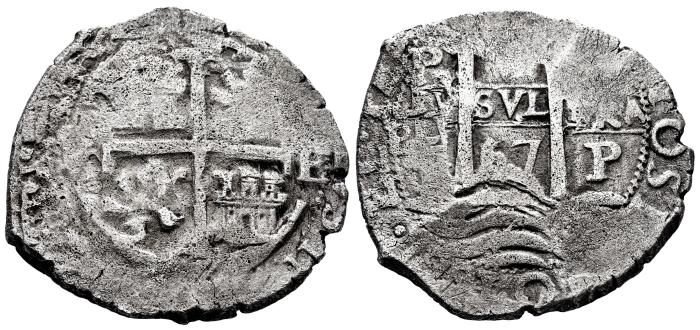
"Seville Harbour"
Shipwreck coins. Charles II (1665-1700). 8 reales. 1667. Potosi. E. (Cal-698). . 26,35 g. Recovered from an unidentified wreck sunk around 1671 in Seville Harbor. Marine oxidation. With photo-certificate of authenticity.
The city of Seville is located on the banks of the Guadalquivir River, about 80 km inland from the ocean port of Cádiz, where the galleons carrying treasure from the New World arrived. From there, the cargo continued upriver to Seville in smaller vessels.
It is believed that, at some point in 1671, one of these vessels sank on the outskirts of Seville, or that at least its cargo was somehow lost in the river. In the mid-1990s, a significant group of Potosí silver cob 8 and 4 reales began to appear on the Spanish market, clearly from a salvage find, with no dates later than 1671 and mostly in good condition. Although initially lacking documented provenance, they were said to have been found in Seville Harbor during the installation of a fiber-optic cable across the river.
It should be noted that coins of the same type, with characteristics identical to those attributed to the Seville wreck, have in recent years been offered as coming from the so-called “Señorita de Santa Cristina”, supposedly sunk in 1672 off Cádiz; however, no documentary evidence has been found for that vessel or its salvage. Choice VF. Est...600,00.
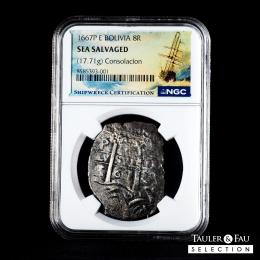
Consolación - NGC
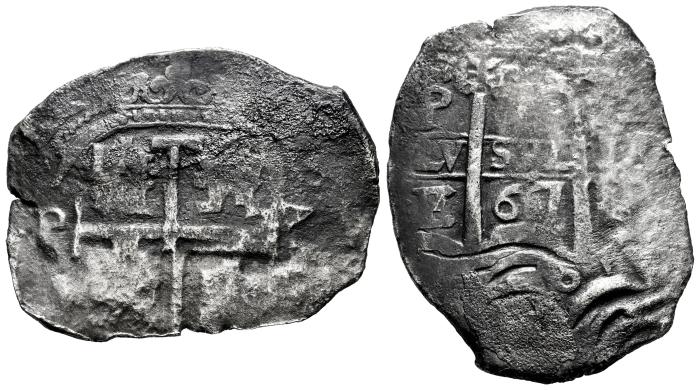
Shipwreck coins. Philip IV (1621-1665). 8 reales. 1667. Potosi. E. (Cal-698). . 17,71 g. Recovered from the wreck of Nuestra Señora de la Consolacion, sunk in 1681 off Santa Clara Island, Ecuador.
Slabbed by NGC as Sea Salvaged. Special "Shipwreck Blue Label".
The Consolacion, a galleon assigned to the 1681 South Seas Fleet, was delayed departing Lima and ended up sailing alone until it reached the Gulf of Guayaquil, where it encountered English pirates under Bartholomew Sharpe.
To prevent capture, the crew deliberately grounded the ship on a reef off Santa Clara Island and set it ablaze, dying as they attempted to escape. Unable to reach the treasure, the pirates killed the surviving Spaniards and failed in their attempts to recover the cargo, which consisted mainly of Potosí silver cobs, along with gold and silver ingots.
The wreck remained untouched until the 1990s, when thousands of coins—many in low grade—were recovered and first auctioned as finds from the “Isla de Muerto.”
Subsequent research confirmed the ship’s true identity, and later discoveries were encapsulated by ANACS for the market. The site still holds promise, as the ship’s manifest listed 146,000 pesos in silver coinage, plus an even larger amount in contraband. Est...500,00.
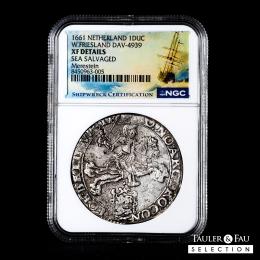
Merestein - XF Details
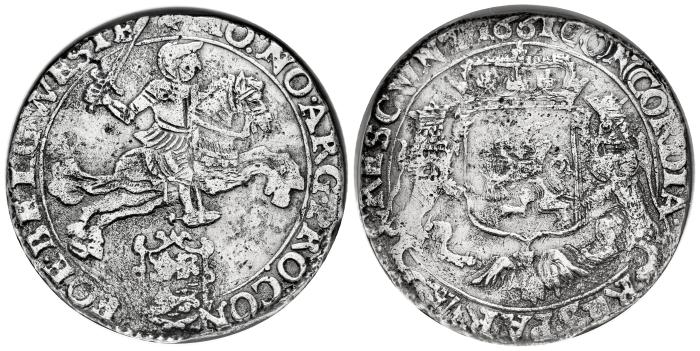
Shipwreck coins. Netherlands. 1 ducaton. 1661. Westfriesland. Westfriesland. (Km-46.1). (Dav-4939). . Recovered from the wreck of the Merestein, sunk in 1702 off the coast of South Africa.
Slabbed by NGC as XF Details, Sea Salvaged. Special “Shipwreck Blue Label”.
The Merestein, a Dutch East India Company ship, was sailing eastward when she attempted to enter Saldanha Bay to relieve the severe scurvy affecting the crew. On 3 April 1702, she struck the reefs at the southwestern end of Jutten Island and, within hours, was smashed to pieces.
The ship carried several chests of silver coins intended for trade in the East Indies, prompting immediate salvage attempts. However, the difficult diving conditions in the area caused the operations to be abandoned until modern times.
The wreck was rediscovered and salvaged in the early 1970s, yielding almost exclusively 17th-century Dutch silver ducatoons. Around 15,000 coins were found at that time, although this is believed to represent only part of the lost treasure. In the 1990s, the company Sealit recovered thousands of additional coins and artifacts. Est...400,00.
Merestein - NGC
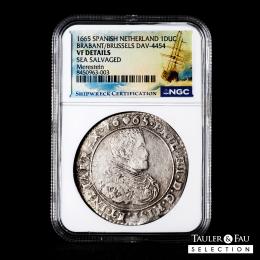
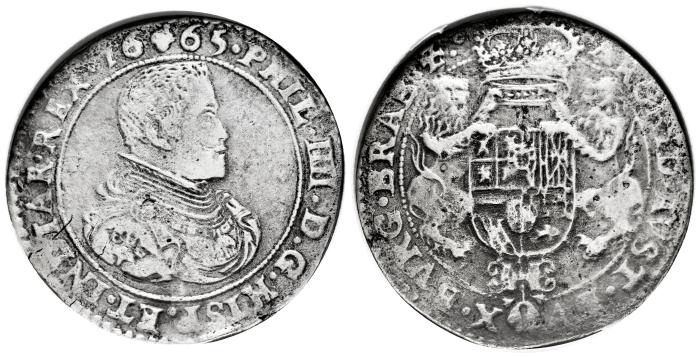
Shipwreck coins. Philip IV (1621-1665). 1 ducaton. 1665. Brussels. (Tauler-2957). (Vti-903). (Vanhoudt-943.BS). . Recovered from the wreck of the Merestein, sunk in 1702 off the coast of South Africa. Slabbed by NGC as VF Details, Sea Salvaged. Special “Shipwreck Blue Label”.
The Merestein, a Dutch East India Company ship, was sailing eastward when she attempted to enter Saldanha Bay to relieve the severe scurvy affecting the crew. On 3 April 1702, she struck the reefs at the southwestern end of Jutten Island and, within hours, was smashed to pieces.
The ship carried several chests of silver coins intended for trade in the East Indies, prompting immediate salvage attempts. However, the difficult diving conditions in the area caused the operations to be abandoned until modern times.
The wreck was rediscovered and salvaged in the early 1970s, yielding almost exclusively 17th-century Dutch silver ducatoons. Around 15,000 coins were found at that time, although this is believed to represent only part of the lost treasure. In the 1990s, the company Sealit recovered thousands of additional coins and artifacts. Est...400,00.
Merestein - NGC
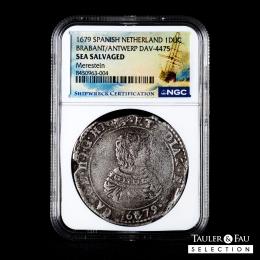
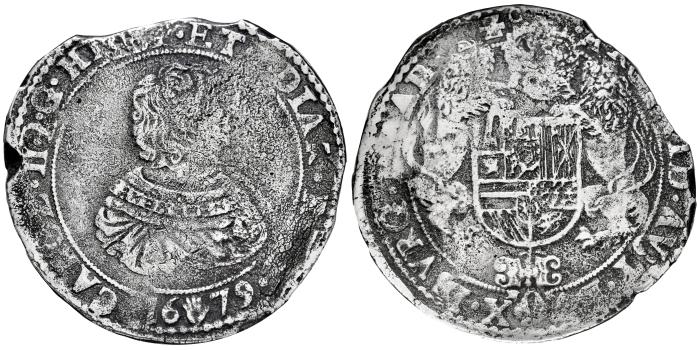
Shipwreck coins. Charles II (1665-1700). 1 ducaton. 1679. Antwerpen. (Tauler-3461). (Vti-490). (Vanhoudt-692.AN). . Recovered from the wreck of the Merestein, sunk in 1702 off the coast of South Africa. Slabbed by NGC as Sea Salvaged. Special “Shipwreck Blue Label”.
The Merestein, a Dutch East India Company ship, was sailing eastward when she attempted to enter Saldanha Bay to relieve the severe scurvy affecting the crew. On 3 April 1702, she struck the reefs at the southwestern end of Jutten Island and, within hours, was smashed to pieces.
The ship carried several chests of silver coins intended for trade in the East Indies, prompting immediate salvage attempts. However, the difficult diving conditions in the area caused the operations to be abandoned until modern times.
The wreck was rediscovered and salvaged in the early 1970s, yielding almost exclusively 17th-century Dutch silver ducatoons. Around 15,000 coins were found at that time, although this is believed to represent only part of the lost treasure. In the 1990s, the company Sealit recovered thousands of additional coins and artifacts. Est...350,00.
H.M.S. Association - NGC
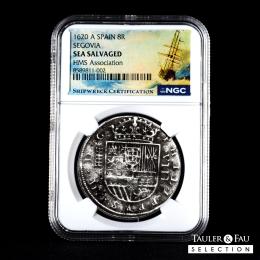
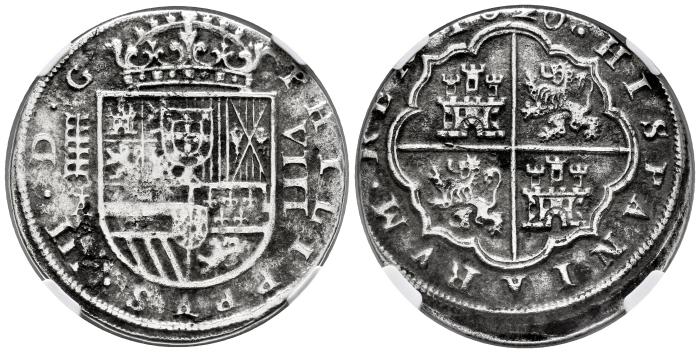
Shipwreck coins. Philip III (1598-1621). 8 reales. 1620. Segovia. A. (Cal-950). . Aqueduct with two rows of five arches. Five fleurs de lis in in Burgundy. Marine oxidation, but with all details complete. Slightly off-center reverse, with the date visible at the base of the digits. Very rare.
Recovered from the wreck of the "H.M.S. Association", sunk in 1707 off the Isles of Scilly, southwest of England.
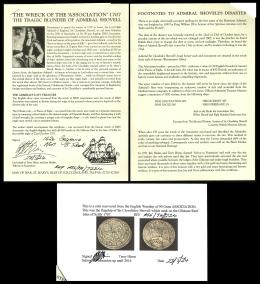
Slabbed by NGC as Sea Salvaged. Special "Shipwreck Blue Label". Includes photo-certificate of authenticity signed by the Salvor in Possession ASS/TH/7224.
A similar specimen struck in Segovia, but of an earlier date, was auctioned by Daniel F. Sedwick on 04/05/2022 and hammered $7,500; another specimen of the mint, but from a later date, was auctioned by Tauler&Fau on 11/12/2025 and hammered €4,800.
The HMS Association sank in 1707 off the Scilly Isles in one of the worst naval disasters in British history. The fleet, returning from the Mediterranean, was caught in a storm, and faulty navigation drove the ships straight onto the reefs.
The vessel went down with a lot of men, including Admiral Sir Cloudesley Shovell, whose personal treasure -ten chests- was believed to be on board. The wreck was located in 1967, triggering years of intensive salvage activity.
Between 1969 and the early 1970s, thousands of coins entered the market at auction, mainly British gold and silver issues, along with numerous Spanish and Spanish-American pieces, notably 8 reales from various mints, including a rare 1676 Royal.
Recovery was especially challenging due to the massive boulders that pinned sections of the wreck to the seabed. Est...1500,00.
1715 Fleet - NGC
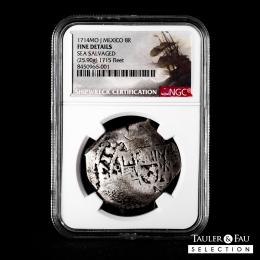
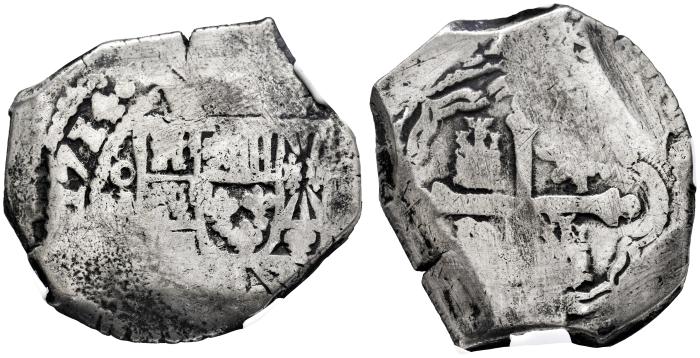
Shipwreck coins. Philip V (1700-1746). 8 reales. 1714. Mexico. (J). (Cal-1401). . 25,90 g. Full date. New-style shield and old-style cross. Rare.
Recovered from the wreck of the Spanish 1715 Fleet, sunk off the east coast of Florida.
Slabbed by NGC as Fine Details, Sea Salvaged. Special “1715 Fleet Shipwreck Label”
The 1715 Fleet, composed of the galleons of Nueva España and Tierra Firme and laden with a vast shipment of gold, silver, jewelry, and high-value goods, sailed from Havana bound for Spain in July of that year. On July 30–31, a hurricane drove the convoy onto the east coast of Florida, where eleven ships were lost, over 1,000 lives perished, and more than 14 million pesos-plus an even greater amount in contraband-were swallowed by the sea.
Although Spanish salvage crews recovered nearly half of the registered treasure, in 1716 the coastal storehouse was raided by British freebooters under Henry Jennings, who carried off some 350,000 pesos.
The remainder of the treasure lay buried beneath the sand for more than two centuries, until the 1950s, when researcher Kip Wagner identified the first traces of the wrecks, leading to the creation of the famed Real Eight Company, later joined by figures such as Mel Fisher.
Since then, Florida's "Treasure Coast" has yielded hundreds of thousands of silver cobs, an exceptional quantity of gold onzas, as well as jewelry, porcelains, and liturgical objects.
Today, the 1715 Fleet is recognized as the largest known source of New World gold cobs and one of the most iconic assemblages in colonial numismatics, its finds originating from multiple wrecksites whose precise identification remains an active subject of research. Est...1500,00.
Caballero de las Yndias - MS 64
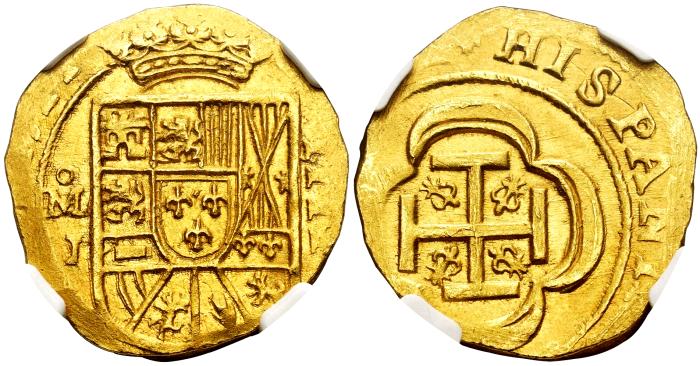
Shipwreck coins. Philip V (1700-1746). 4 escudos. 1714. Mexico. J. (Cal-2029). (Tauler-110). (Km-55.2). . Superb specimen. Very well centered, with complete shield, crown and cross. Full date visible at the bases, with mintmark, assayer mark and denomination also visible. Strong strike with remarkable detail and slightly flat peripheries.
Lovely deep yellow color, pristine surfaces and splendid original luster that enhance its extraordinary eye appeal. Rare in this condition and with a desirable pedigree.
Recovered from the wreck of the Spanish Treasure Fleet of 1715, which sank off the east coast of Florida.
Slabbed by NGC as MS 64.
Ex Caballero de las Yndias Collection, Áureo & Calicó (08/04/2009), lot 346. Est...30000,00.
Vliegenthart - NGC
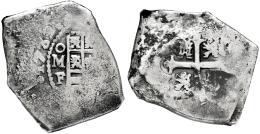
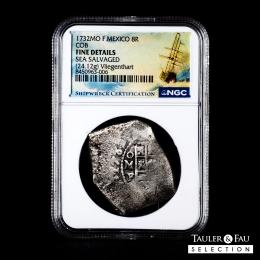
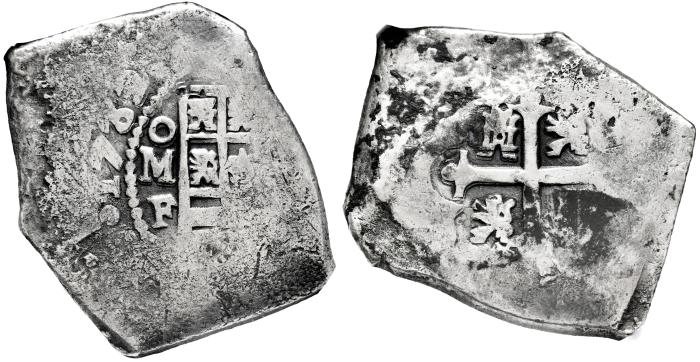
Shipwreck coins. Philip V (1700-1746). 8 reales. 1732. Mexico. F. (Cal-1427). . 24,12 g. Four-digit date, with off-center strike. Much of the cross visible, with extensive flat areas and some corrosion at the peripheries. Toned.
Recovered from the wreck of the “Vliegenthart”, sunk in 1735 off Zeeland, Netherlands.
Slabbed by NGC as Fine Details, Sea Salvaged. Special “Shipwreck Blue Label”
The Vliegenthart, was a Dutch East India Company vessel lost in 1735 off Zeeland, shortly after departing for the East Indies. A northeast gale, combined with a spring tide and pilot error, drove the ship onto a sandbank behind her sister ship, the Anna Catharina. Both vessels were lost with all hands.
Contemporary salvage attempts failed, but a secret chart later enabled the wreck to be located in 1981. From 1983 onwards, divers recovered important monetary consignments intended for the East India trade, including chests of Mexican silver and Dutch gold coinage, as well as smaller boxes of large Dutch silver coins known as ducatoons, which had been exported illegally.
Among the most significant finds were thousands of Mexican cobs, chiefly 8 reales, many bearing clear dates from the early 1730s and preserved in excellent condition. Est...500,00.
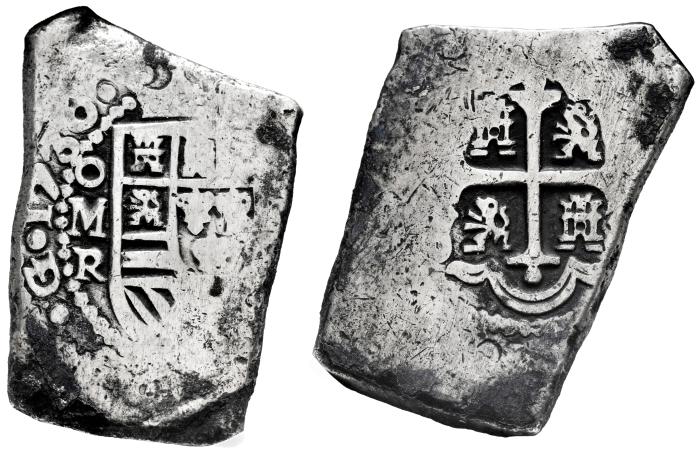
Rooswijk - NGC
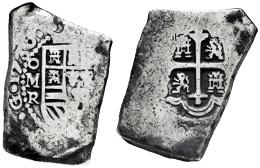
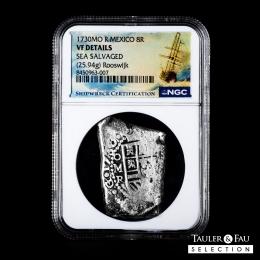
Shipwreck coins. Philip V (1700-1746). 8 reales. 1730. Mexico. R. (Cal-1416). . 25,94 g. Full date, mintmark and assayer visible. Rectangular flan with hardly any marine corrosion. Rare.
Recovered from the wreck of the “Rooswijk”, sunk in 1739 off southeastern England.
Slabbed by NGC as VF Details, Sea Salvaged. Special “Shipwreck Blue Label”
The Rooswijk, a Dutch East Indiaman, sank in 1739 on the treacherous Goodwin Sands off southeast England, going down with her entire crew and 30 treasure chests.
The wreck remained buried under shifting sandbanks until 2004, when changing tides exposed it and allowed the recovery of two complete chests and hundreds of silver ingots. Salvage operations continued in 2005 under official supervision.
Since then, the market has seen hundreds of Mexican silver cobs from the 1720s–1730s, several transitional klippes dated 1733–1734, and numerous pillar dollars, along with a handful of pieces from other mints. Est...900,00.
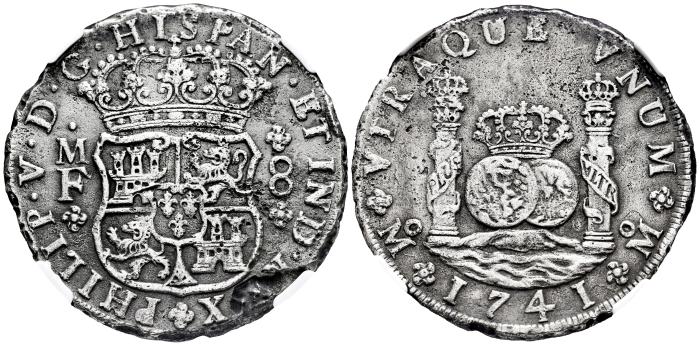
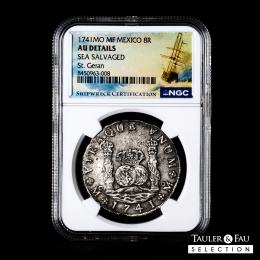
St. Geran - AU Details
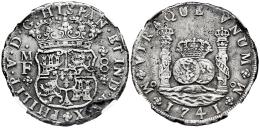
Shipwreck coins. Philip V (1700-1746). 8 reales. 1741. Mexico. MF. (Cal-1458). . Saltwater damage.
Recovered from the wreck of the St. Geran, sunk in 1744 off the coast of Mauritius, in the Indian Ocean.
Slabbed by NGC as AU Details, Sea Salvaged. Special “Shipwreck Blue Label”.
The story of the sinking of the St. Geran includes the tragic death of a young French woman who was returning from France to idyllic Mauritius, then known as Île de France, together with her betrothed, a member of the crew. According to tradition, her death was due to her modest refusal to remove her clothing in order to avoid drowning, tragically choosing modesty over survival.
In 1788, this anecdote became the core of the successful novel Paul et Virginie, by the French author Jacques-Henri Bernardin de Saint-Pierre, which also extolled the virtues of living in harmony on an island, free from the constraints of social class divisions. Est...600,00.
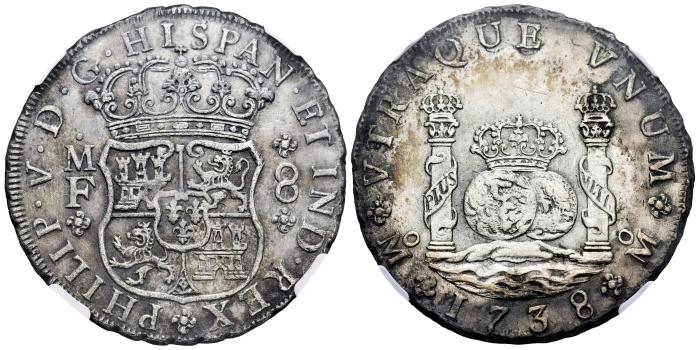
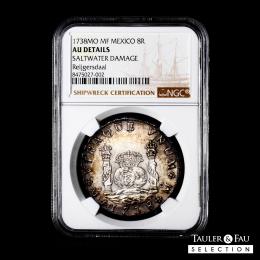
Reijgersdaa - AU Details
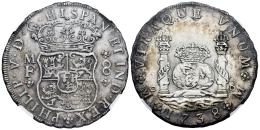
Shipwreck coins. Philip V (1700-1746). 8 reales. 1738. Mexico. MF. (Cal-1449). . Sharp details, with practically no corrosion, though with dark staining around the rim on the pillars side; the shield side shows even toning.
Recovered from the wreck of the “Reijgersdaal”, sunk in 1747 off the coast of South Africa.
Slabbed by NGC as AU Details, Saltwater Damage. Special “Shipwreck Blue Label”
The Reijgersdaal, a Dutch East India Company vessel, sank in 1747 between Robben and Dassen Islands while carrying eight chests containing nearly 30,000 silver coins, mostly Mexican pillar dollars in near-mint condition.
A storm snapped the anchor line and drove the ship onto the rocks, killing most of the crew and allowing only a single incomplete chest to be recovered.
The site was deemed too dangerous for further salvage, and it was not until 1979 that modern recovery began, yielding thousands of coins, including a small but significant group of Guatemalan and Upper Peru cobs-extremely rare in shipwreck contexts. Est...900,00.
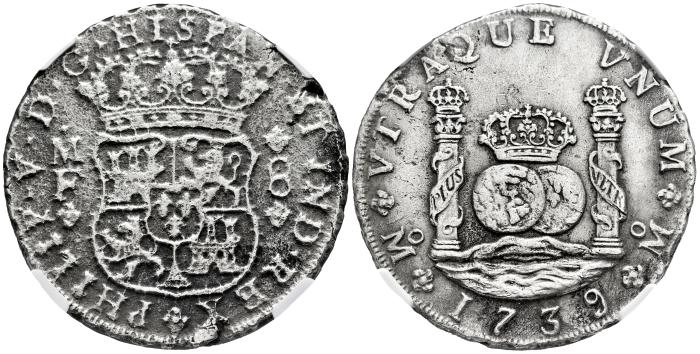
Reijgersdaal - NGC
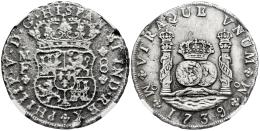
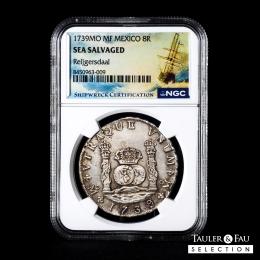
Shipwreck coins. Philip V (1700-1746). 8 reales. 1739. Mexico. MF. (Cal-1453). . Saltwater damage, more pronounced on the reverse.
Recovered from the wreck of the “Reijgersdaal”, sunk in 1747 off the coast of South Africa.
Slabbed by NGC as Sea Salvaged. Special “Shipwreck Blue Label”
The Reijgersdaal, a Dutch East India Company vessel, sank in 1747 between Robben and Dassen Islands while carrying eight chests containing nearly 30,000 silver coins, mostly Mexican pillar dollars in near-mint condition.
A storm snapped the anchor line and drove the ship onto the rocks, killing most of the crew and allowing only a single incomplete chest to be recovered.
The site was deemed too dangerous for further salvage, and it was not until 1979 that modern recovery began, yielding thousands of coins, including a small but significant group of Guatemalan and Upper Peru cobs-extremely rare in shipwreck contexts. Est...600,00.
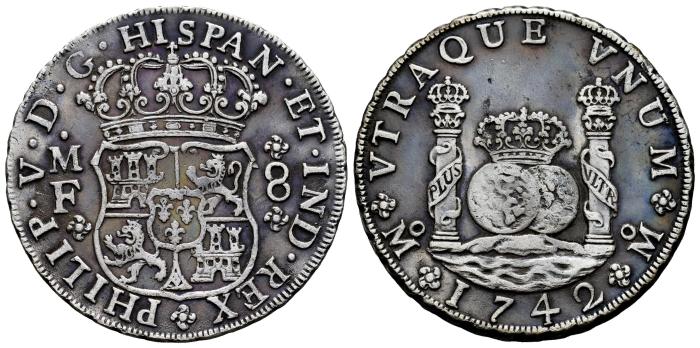
Reijgersdaal - NGC
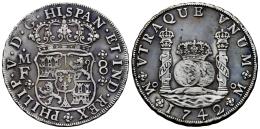
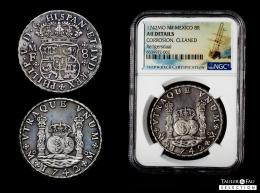
Shipwreck coins. Philip V (1700-1746). 8 reales. 1742. Mexico. MF. (Cal-1461). . 26,38 g. Slight corrosion, subsequently cleaned, but a fine specimen.
Recovered from the "Reijgersdaal" shipwreck, sunk in 1747 off the coast of South Africa.
Slabbed by NGC as AU Details, Corrosion, Cleaned, with the special "Shipwreck Blue Label" label.
The Reijgersdaal, a Dutch East India Company vessel, sank in 1747 between Robben and Dassen Islands while carrying eight chests containing nearly 30,000 silver coins, mostly Mexican pillar dollars in near-mint condition.
A storm snapped the anchor line and drove the ship onto the rocks, killing most of the crew and allowing only a single incomplete chest to be recovered.
The site was deemed too dangerous for further salvage, and it was not until 1979 that modern recovery began, yielding thousands of coins, including a small but significant group of Guatemalan and Upper Peru cobs-extremely rare in shipwreck contexts. Est...900,00.
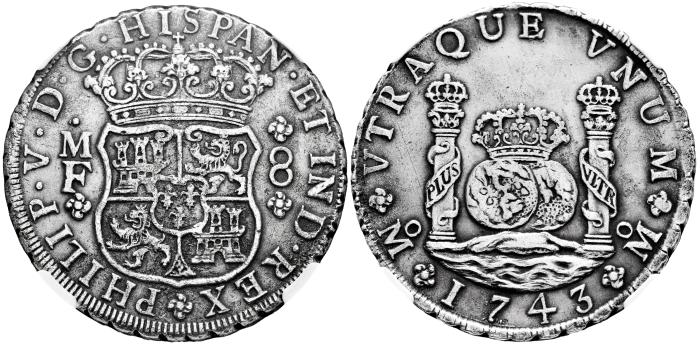
Reijgersdaal - AU Details
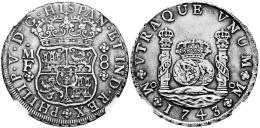
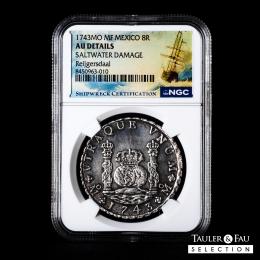
Shipwreck coins. Philip V (1700-1746). 8 reales. 1743. Mexico. MF. (Cal-1463). . Light tone and practically no corrosion.
Recovered from the wreck of the “Reijgersdaal”, sunk in 1747 off the coast of South Africa.
Slabbed by NGC as AU Details Saltwater Damage. Special “Shipwreck Blue Label”
The Reijgersdaal, a Dutch East India Company vessel, sank in 1747 between Robben and Dassen Islands while carrying eight chests containing nearly 30,000 silver coins, mostly Mexican pillar dollars in near-mint condition.
A storm snapped the anchor line and drove the ship onto the rocks, killing most of the crew and allowing only a single incomplete chest to be recovered.
The site was deemed too dangerous for further salvage, and it was not until 1979 that modern recovery began, yielding thousands of coins, including a small but significant group of Guatemalan and Upper Peru cobs-extremely rare in shipwreck contexts. Est...900,00.
X
Confirm your maximum bid
Conecting
 English
 Español





 0
 0