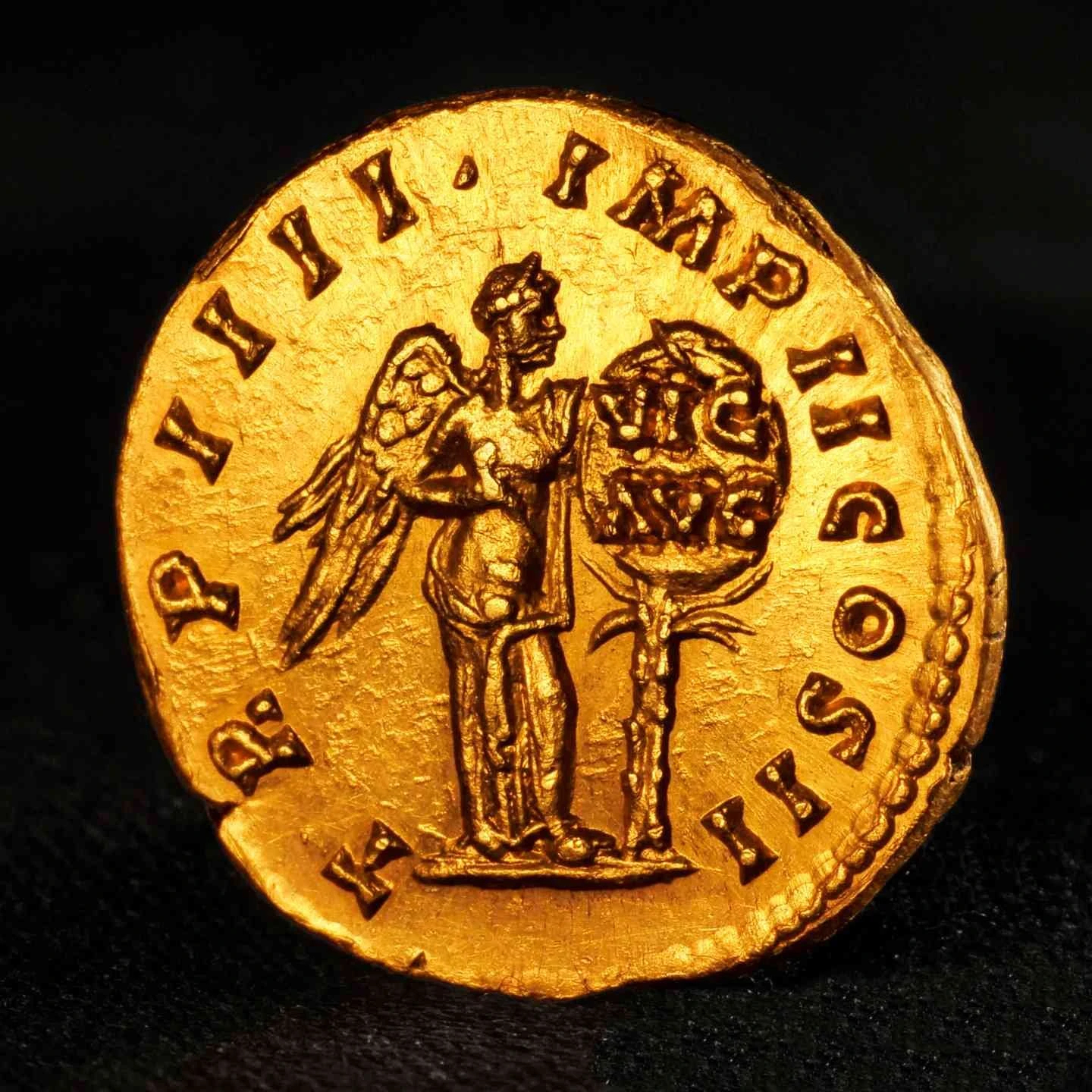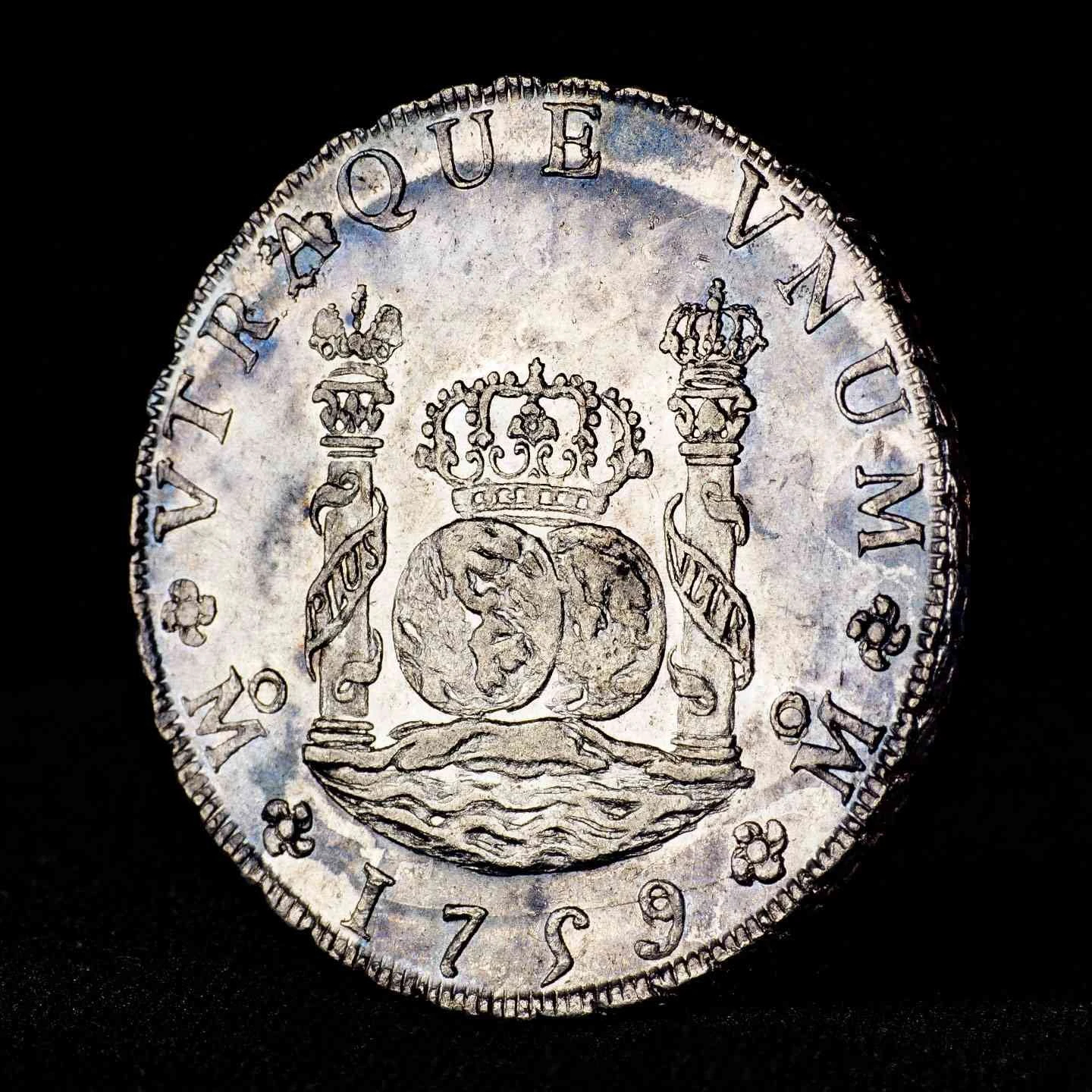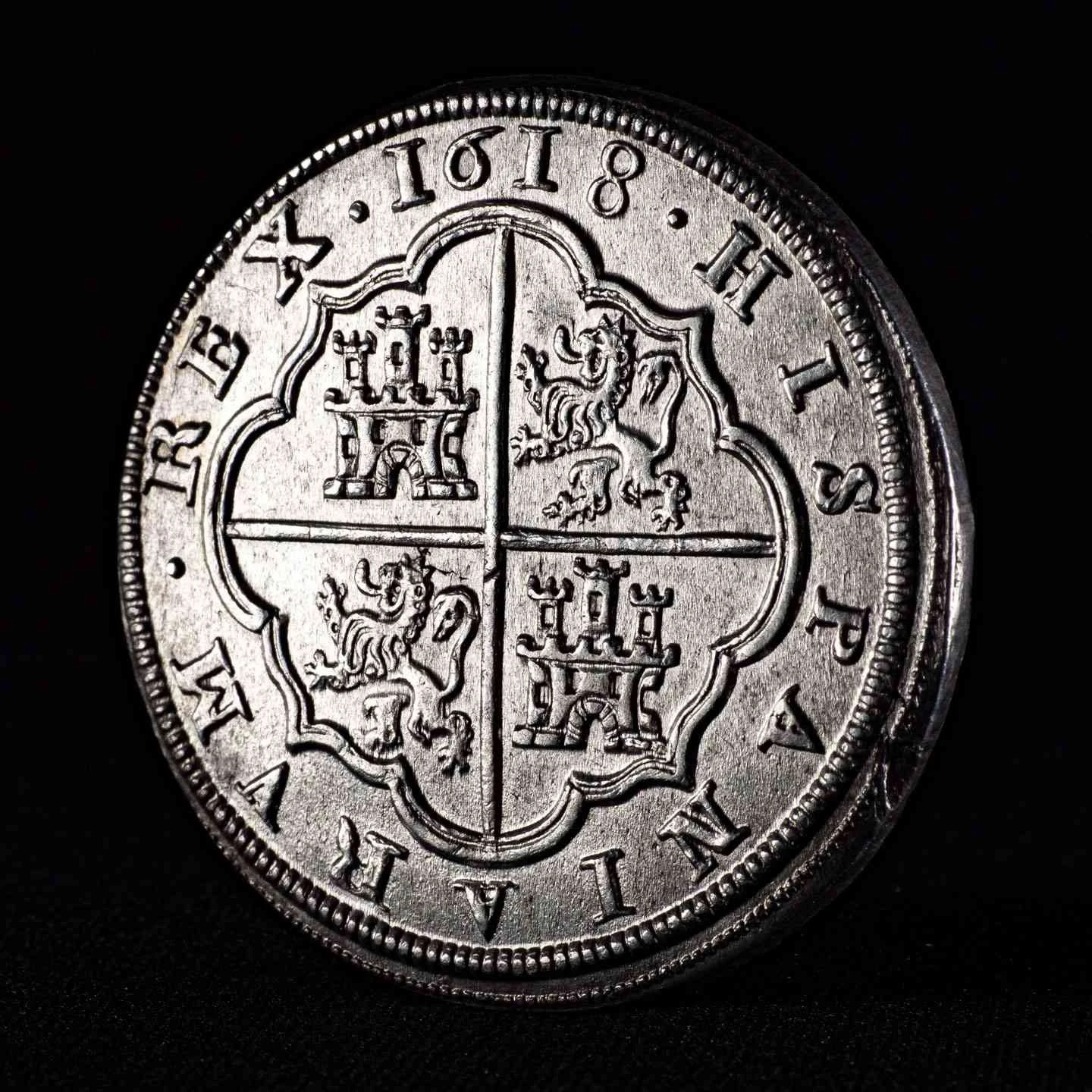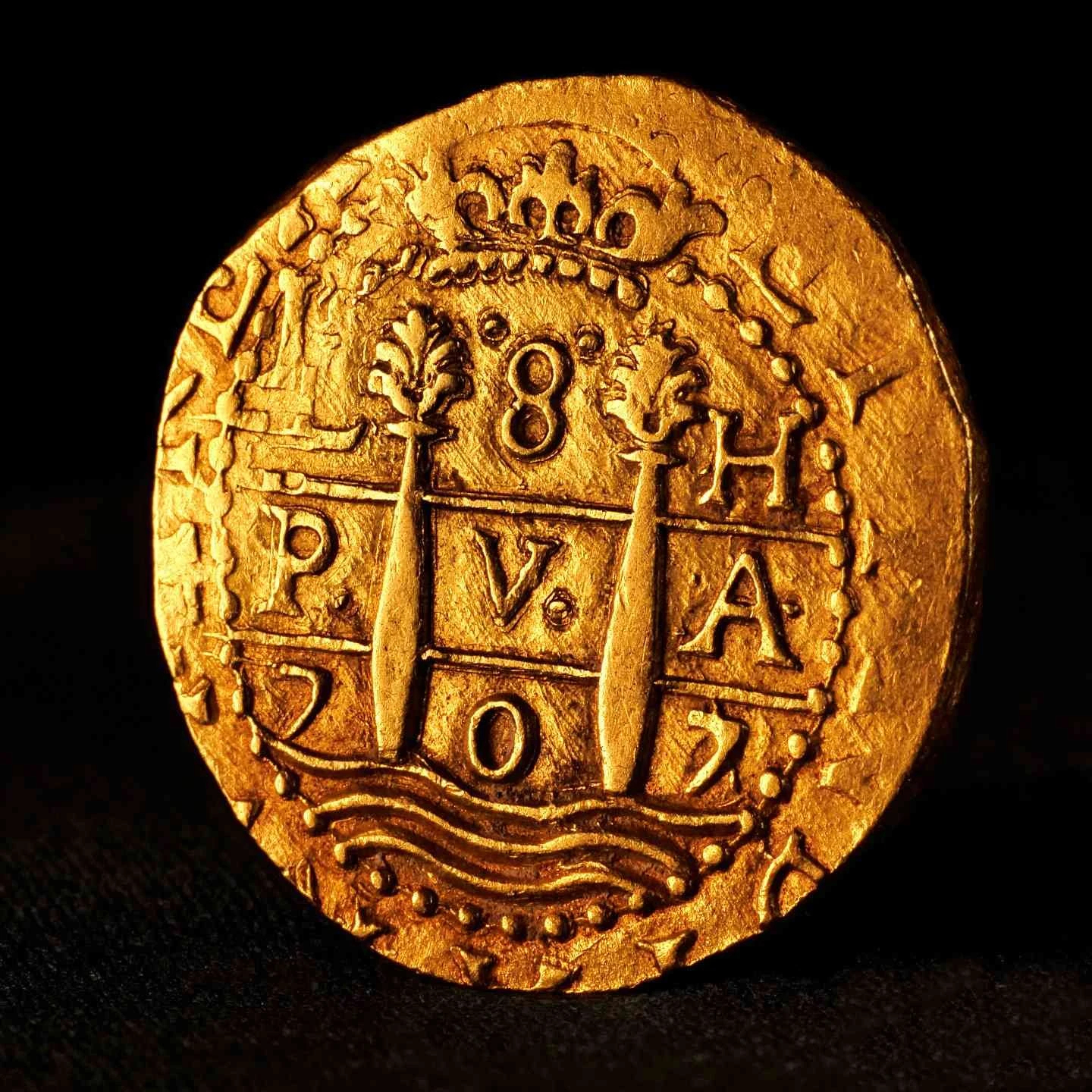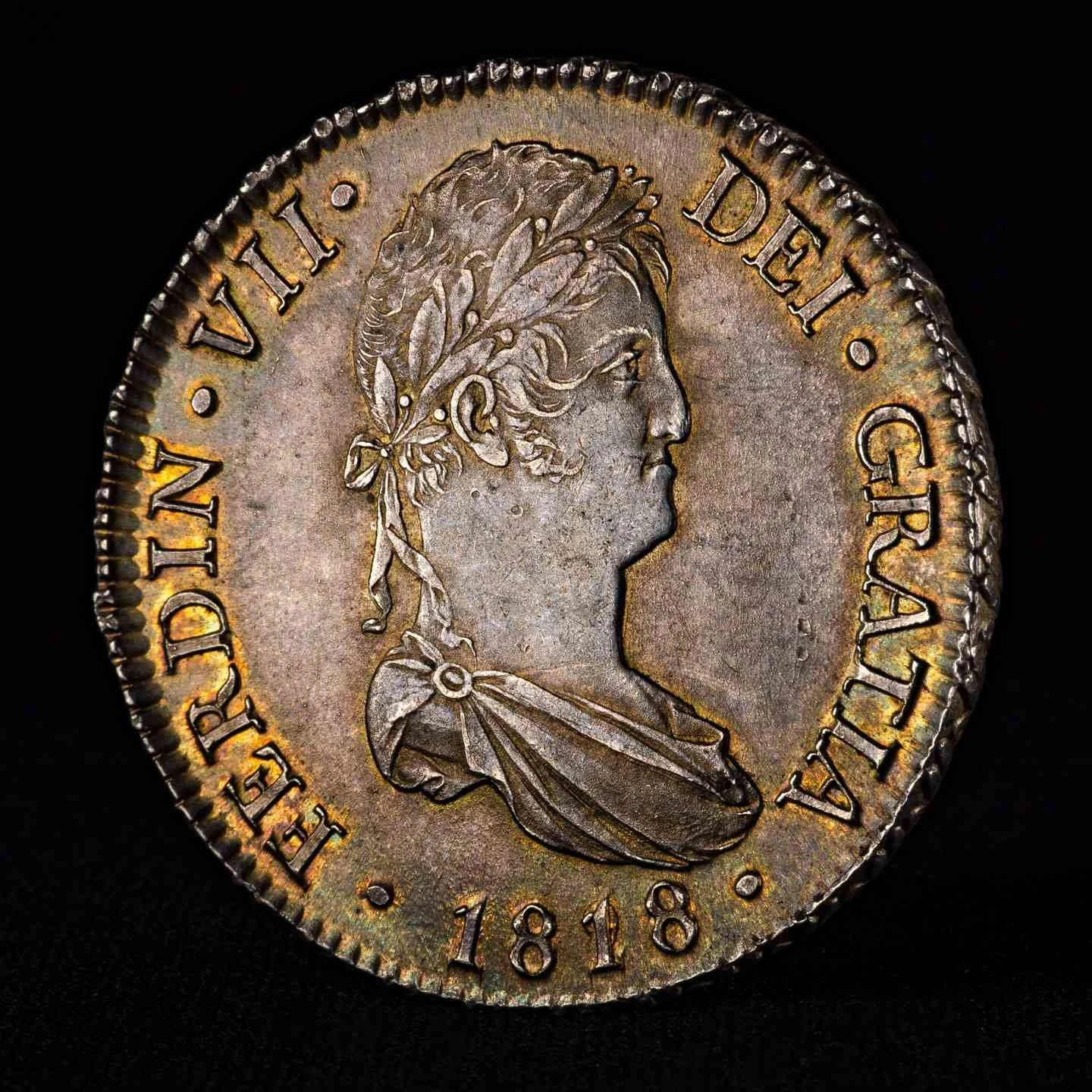
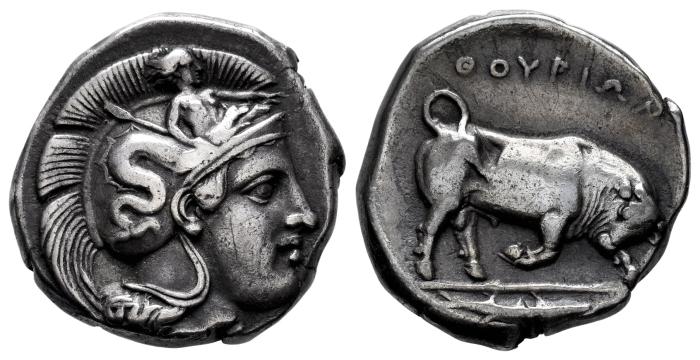
Lucania. Thourioi. Nomos. 400-350 BC. (HN Italy-1802). (Sng Ans-1002). Anv.: Head of Athena to right, wearing crested Attic helmet adorned, on the bowl, with Skylla holding an oar?. Rev.: ΘΟΥΡΙΩΝ Bull butting to right; in exergue, fish to right. . 7,67 g. Delicate patina with lightly tone. Choice VF. Est...400,00.
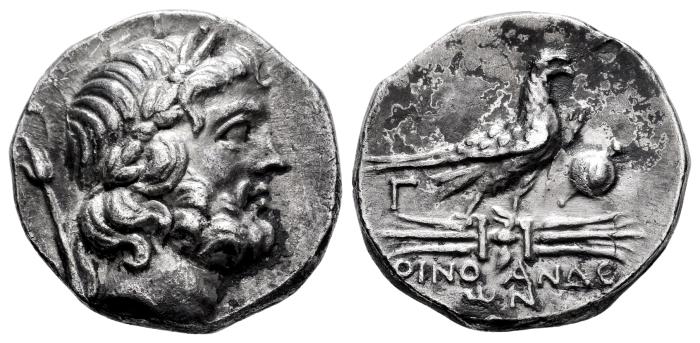
Lycia. Oinoanda. Didrachm. 187-185 BC. (Ashton-Oinoanda, 7 (A4/P3A)). (Bmc-1). Anv.: Laureate head of Zeus right; lotus-tipped sceptre behind. Rev.: Eagle standing right on thunderbolt; Γ to left, round shield over sword to right; OINO-ANΔЄ / ѠN in exergue. . 8,24 g. Light toning, slightly uneven on the reverse. Rare. Choice VF. Est...600,00.
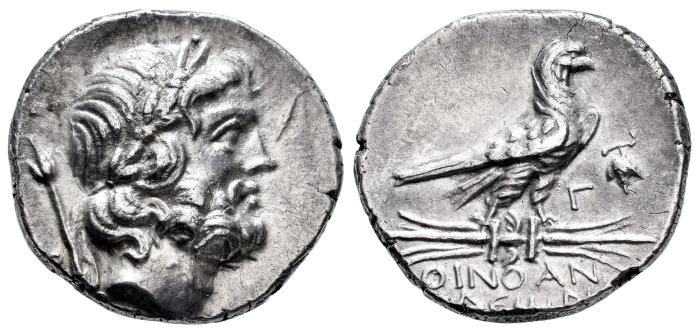
Lycia. Oinoanda. Didrachm. 187-185 BC. (Ashton-Oinoanda, 13y (A4/P9)). (Bmc-Lycia pg. 73, 1). Anv.: Laureate head of Zeus right; B and lotus-tipped sceptre behind. Rev.: Eagle standing right on thunderbolt; Γ and bunch of grapes to right; OINO-AN / ΔЄѠN in exergue. . 8,23 g. Attractive, well-centered specimen with original luster. Rare. XF. Est...900,00.
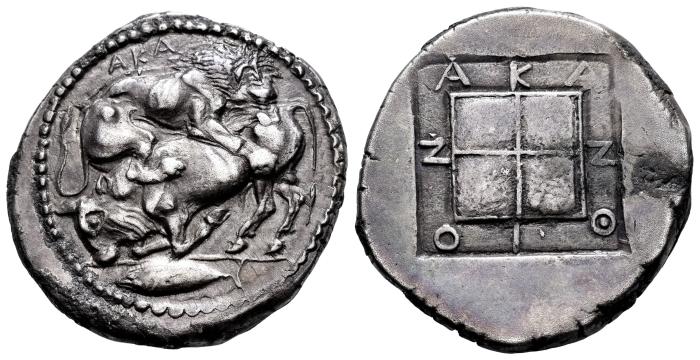
Macedon. Akanthos. Tetradrachm. 470-430 BC. (cf. Desneux-Unlisted. Type 92 similar obv.; quadripartite rev.). Anv.: Lion right, attacking bull crouching left, biting into its hindquarter; AKA above; in exergue, fish (Tunny?) left. Rev.: AKA-N-ΘIO-N in shallow incuse square around quadripartite square in relief. . 17,14 g.
Magnificent specimen of fine style, with deep reliefs and exceptionally fine engraving that reflects the mastery of classical art. Attractive, uniform toning enhances the details and depth of the design. Light deposits on the edge, of little significance and not detracting from its excellent eye appeal.
A similar specimen was offered by Classical Numismatic Group in Triton XXIII (January 2020), lot 186.
Akanthos was situated on the eastern coast of Chalcidice, near the narrowest point of the Athos peninsula. Tradition attributes its founding, around 655 BC, to colonists from Andros. Its economic development relied on exploiting local resources, including agriculture, timber from surrounding forests, and most notably, silver from deposits in the Thracian-Macedonian hinterland.
Akanthos was distinguished by its prolific coinage, particularly its tetradrachms from the Archaic and Classical periods. The wide distribution of these issues, evidenced by finds as far afield as Sicily, Egypt, and Persia, highlights the city's extensive commercial reach. Their presence in contexts so far removed from the local sphere suggests that many of these pieces circulated as minted silver, functioning more like monetized bullion than currency intended solely for local use. XF/Almost XF. Est...4000,00.
Ex Lanz, 2005
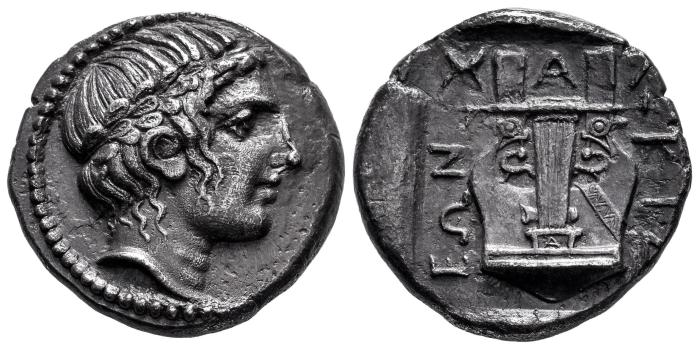
Macedon. Chalkidian League. Tetradrachm. 380 BC. Olynthos. (Robinson & Clement-Excavations at Olynthus IX: The Chalcidic mint and the excavation coins found in 1928-1934 (1938), (vgl. 7)). Anv.: Laureate head of Apollo right. Rev.: Kithara of six? strings, XAΛKIΔEΩN around, A engraved on the bridge of the strings; all within incuse square. . 13,36 g.
Very nice dark patina. High-relief strike of fine style. Slight traces of corrosion on the reverse. Particularly noteworthy for the letter A engraved on the bridge of the cithara, an unusual feature for which we have not traced any other specimens. Very rare and of particular interest to specialist collectors.
Ex Numismatik Lanz, Auction 123 (30/05/2005), lot 164. XF/Almost XF. Est...3000,00.
Ex Italo Vecchi, 1997
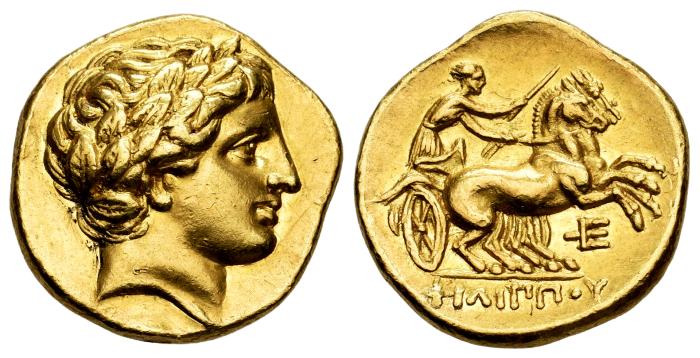
Kingdom of Macedon. Philip II. Stater. 359-336 BC. Amphipolis. Struck under Antipater, Polyperchon or Kassander. (Le Rider-pl. 80, 204). (Sng Cop-603). Anv.: Laureate head of Apollo right. Rev.: Charioteer driving galloping biga right, holding kentron and reins; trident below, ΦΙΛΙΠΠΟΥ in exergue. . 8,58 g.
A beautiful specimen retaining traces of its original luster and a stunning, deep yellow color. Struck in high relief with full detail and perfectly centered.
Ex Italo Vecchi 5 (05/03/1997). AU. Est...4000,00.
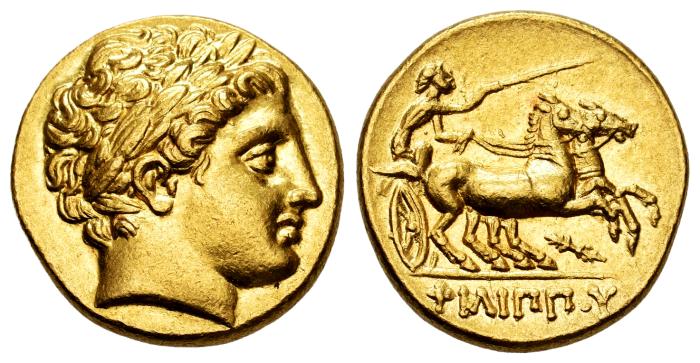
Kingdom of Macedon. Philip II. Stater. 359-336 BC. Pella. Struck under Antipater or Polyperchon. (Le Rider-pl. 66, 419 (D188/R309)). (Sng Ans-130/7). (Hgc-3.1, 847). Anv.: Laureate head of Apollo to right. Rev.: Charioteer driving biga to right, holding goad in his right hand and reins in his left; below horses, thunderbolt; ΦΙΛΙΠΠΟΥ in exergue. . 8,59 g.
Superb specimen. High-relief strike, perfectly centered and with all details visible. Original luster. Almost MS/AU. Est...5000,00.
Ex Triton VI, 2003
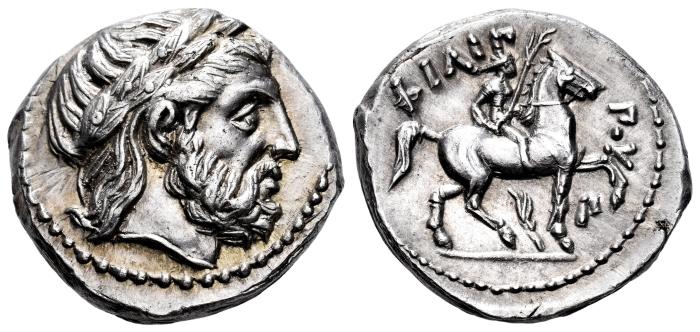
Kingdom of Macedon. Philip II. Tetradrachm. 323-317 BC. Amphipolis. (Le Rider-pl. 46, 18). (Troxell-Group 8, 317). (SNG Ans-738). Anv.: Laureate head of Zeus to right. Rev.: Youth on horseback to right, holding reins and long palm branch; aphlaston below, Π below raised foreleg, ΦΙΛΙΠΠΟΥ around.. . 14,26 g. Perfectly sharp strike with an excellent level of detail. Light toning and full original luster. Very attractive and rare in this grade.
Ex Classical Numismatic Group, Triton VI (14/01/2003), lot 154. Almost MS/AU. Est...1800,00.
Ex Gerhard Hirsch, 1997
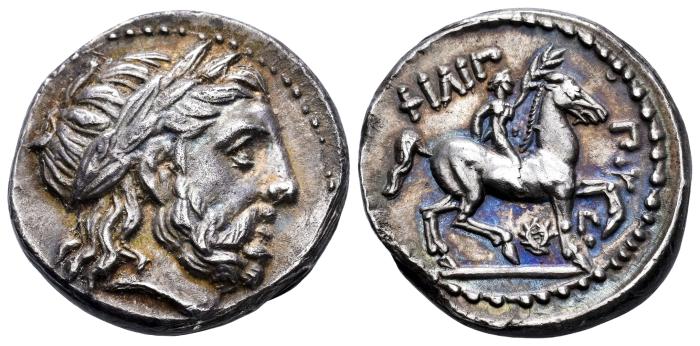
Kingdom of Macedon. Philip II. Tetradrachm. 323-316 BC. Amphipolis. (Le Rider-Ph. p. 124 and pl. 46, 14). (Sng Ans-747). (SNG München-117). Anv.: Laureate head of Zeus right. Rev.: ΦIΛIΠ - ΠOY. Naked youth right on horseback, holding long branch with his right hand, the reins with his left hand; below horse, wreath and Π°. . 14,25 g.
A magnificent and lovely specimen with an excellent strike and remarkable detail. Soft toning with subtle golden highlights and bluish hues, more pronounced on the reverse.
Ex Gerhard Hirsch Nachfolger 196 (24/09/1997). AU. Est...1800,00.
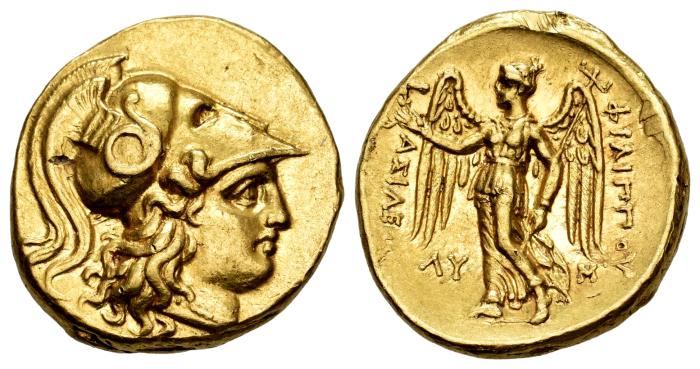
Kingdom of Macedon. Philip III Arrhidaios. Stater. 323-317 BC. Babylon. Struck under Archon, Dokimos or Seleukos I. (Price-P178). Anv.: Head of Athena to right, wearing crested Corinthian helmet decorated with a coiled serpent. Rev.: ΦΙΛΙΠΠΟΥ - ΒΑΣΙΛΕΩΣ. Nike standing front, head to left, with her wings spread, holding laurel wreath in her right hand and stylis in her left; to lower left, ΛY; to lower right, M. . 8,55 g.
Nice specimen with luster. Bold strike with all details sharply defined. Slight friction on the reverse rim at 12 o’clock; nevertheless, very attractive and rare in this grade. AU. Est...4000,00.
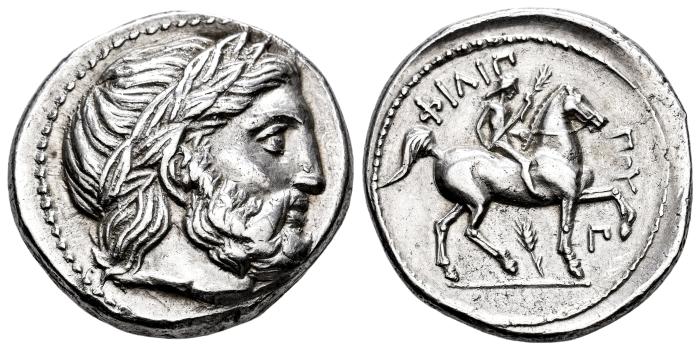
Kingdom of Macedon. Philip III Arrhidaios. Tetradrachm. 323-317 BC. Amphipolis. Struck under Polyperchon. In the types of Philip II. (Le Rider-pl. 46, 3). (Troxell-group 8, 314). (SNG Ans-667/73). Anv.: Laureate head of Zeus right. Rev.: Youth on horseback right, holding reins and long palm branch; grain ear below, Π below raised foreleg. . 14,31 g.
Nice specimen. Lightly cleaned on the reverse. Rare.
Ex Áureo & Calicó, Auction 307 (25/04/2018), lot 2005.. XF. Est...900,00.
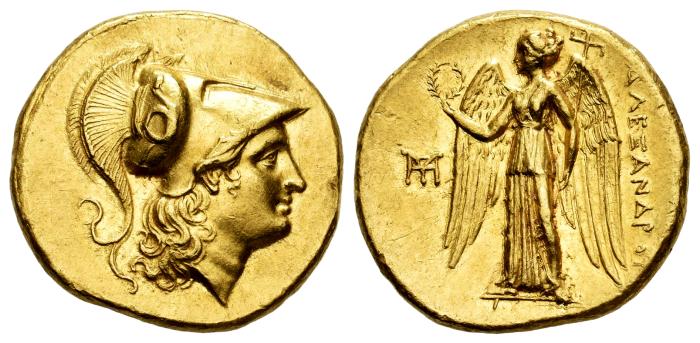
Kingdom of Macedon. Alexander III, "The Great". Stater. 336-323 BC. Uncertain mint in western Asia Minor. (Price-Unlisted). Anv.: Head of Athena to right, wearing crested Corinthian helmet decorated with a coiled serpent. Rev.: AΛEΞANΔΡOΥ Nike standing front, head to left, with her wings spread, holding laurel wreath in her right hand and stylis in her left; to left, unknown ΠYO monogram. . 8,53 g.
Magnificent specimen with original luster and a lovely intense yellow color. Exceptionally fine-style strike in high relief, with all details sharply defined. Perfectly centered. Very rare. Almost MS. Est...5000,00.
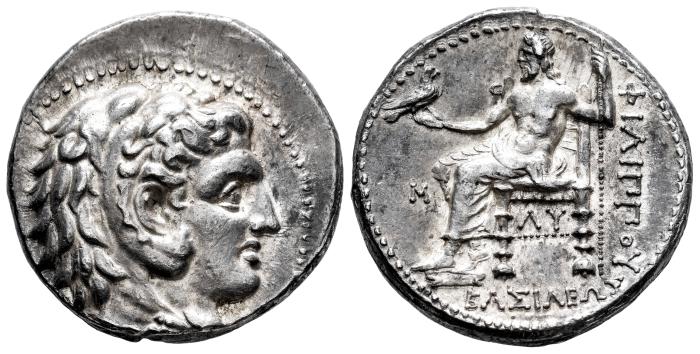
Kingdom of Macedon. Alexander III, "The Great". Tetradrachm. 323-319 BC. Babylon. Struck under Philip III. (Price-3692). Anv.: Head of Herakles to right, wearing lion skin headdress. Rev.: ΒΑΣΙΛΕΩΣ / AΛEΞANΔPOY. Zeus seated left on low throne, holding long scepter in his left hand and eagle standing right with closed wings in his right; in field to left, M; below throne, ΛΥ. . 17,15 g.
Soft toning with traces of underlying luster. XF. Est...900,00.
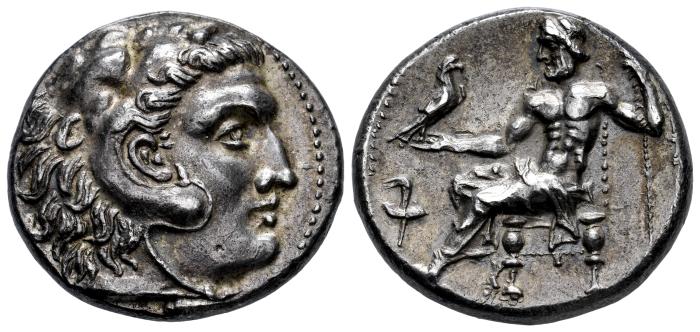
Kingdom of Macedon. Alexander III, "The Great". Tetradrachm. 325-300 BC. Uncertain eastern mint. (Price-4001). Anv.: Head of Herakles right, wearing lion skin headdress. Rev.: Zeus Aëtophoros seated left, holding sceptre; torch in left field, (ΒΑΣΙΛΕΩΣ) below, (ΑΛΕΞΑΝΔΡΟΥ) to right. . 16,89 g.
Magnificent specimen with sharply defined details and lovely toning, retaining traces of underlying original luster. Rare in this grade. AU. Est...700,00.
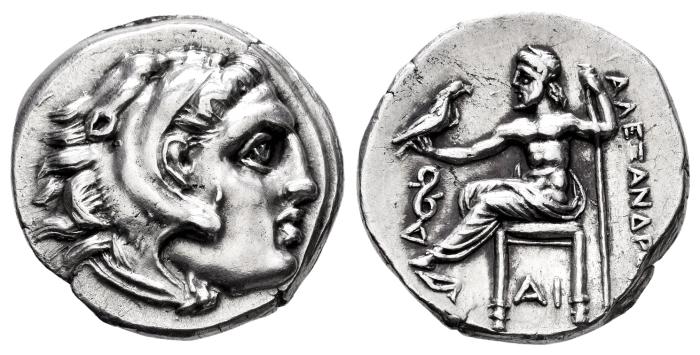
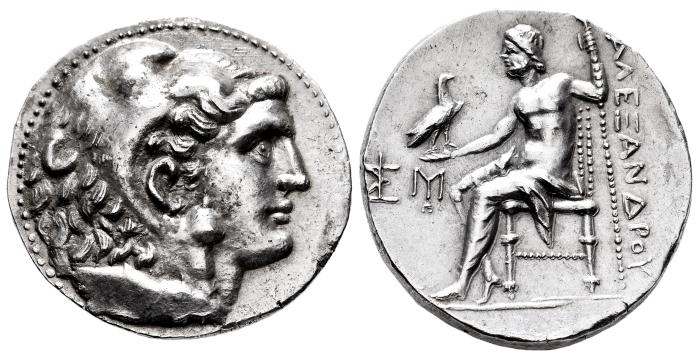
Kingdom of Macedon. Alexander III, "The Great". Drachm. 323-317 BC. Lampsakos. Struck under Philip III. (Price-1979A). Anv.: Head of Herakles to right, wearing lion skin headdress. Rev.: AΛEΞANΔPOY Zeus seated left on low throne, holding long scepter in his left hand and eagle standing right with closed wings in his right; in field to left, buckle above Δ; below throne, AI. . 4,20 g.
Golpecito en el anvero. Buena acuñación, bien centrada. XF. Est...200,00.
Ex Gerhard Hirsch, 2010
Kingdom of Macedon. Antigonos II Gonatas. Tetradrachm. 277/6-275 BC. Amphipolis. In the name and types of Alexander III. (Price-605f). (Müller-921). Anv.: Head of Herakles to right, wearing lion-skin headdress. Rev.: AΛEΞANΔPOY. Zeus seated left on a low throne, holding a long scepter in his left hand and an eagle standing right with folded wings in his right; two monograms in the left field. . 17,02 g.
Extremely rare. Mathisen records only one specimen listed in PELLA, while we have traced only two specimens on ACSearch, including the present example.
Ex Gerhard Hirsch, Auction 269 (23/09/2010), lot 2404. Almost XF/XF. Est...800,00.
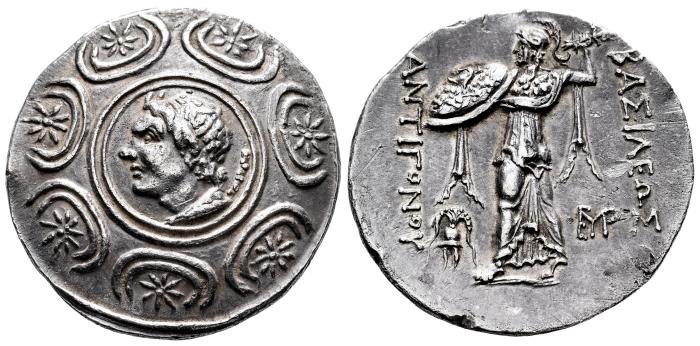
Kingdom of Macedon. Antigonos II Gonatas. Tetradrachm. 252/1-246 BC. Amphipolis or Pella mint. (TEA-Period II, 50 (O4/R49)). (Hgc-3, 1042). Anv.: Horned head of Pan left, lagobolon over shoulder, in the center of a Macedonian shield. Rev.: ΒΑΣΙΛΕΩΣ ΑΝΤΙΓΟΝΟΥ. Athena Alkidemos advancing left, holding shield decorated with aegis, preparing to cast thunderbolt; crested Macedonian helmet to inner left, monogram to inner right. . 16,95 g.
Sharp strike with well-defined details. Soft, uniform toning. Small marks on the edge, visible on the reverse, possibly associated with an old mount. Nevertheless, very attractive. XF. Est...1000,00.
Ex CNG, 2003
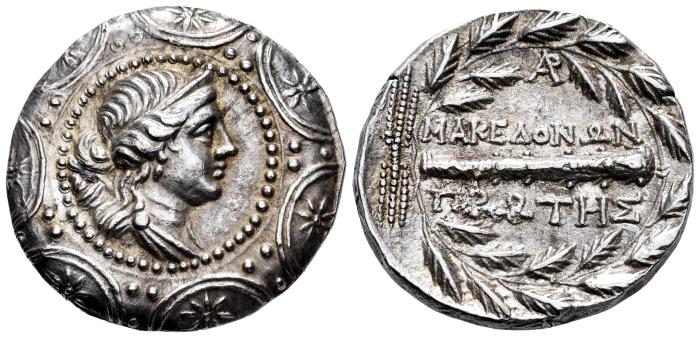
Macedon under Roman Rule. Tetradrachm. 167-149 BC. Amphipolis. Republican period. First Meris. (AMNG-III 159). (Sng Cop-1310/1). (Sng Ashmolean-3292). Anv.: Diademed and draped bust of Artemis to right, bow and quiver over her shoulder; all at the center of a Macedonian shield ornamented with stars within crescents. Rev.: MAKEΔONΩN / ΠΡΩTHΣ Club to right; above, monogram of AP; around, oak wreath with ties to left; to left of the ties, thunderbolt. . 16,82 g.
Nice toning with subtle golden hues. Very attractive, well-centered and rare in this grade.
Ex Classical Numismatic Group 63 (21/05/2003), lot 217. XF. Est...800,00.
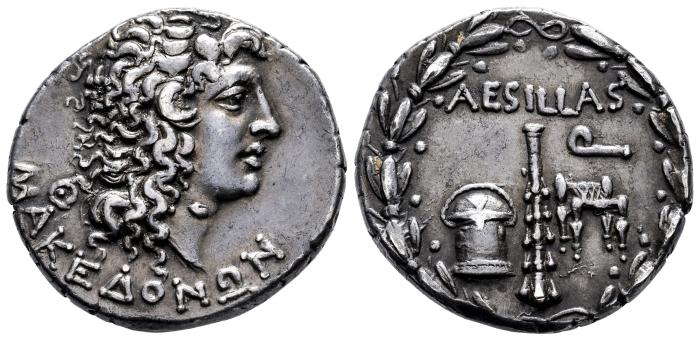
Macedon under Roman Rule. Aesillas, Quaestor. Tetradrachm. 95-70 BC. (AMNG-223). (Sng Cop-1330). (Hgc-3.1, 1110). Anv.: Head of the deified Alexander III 'the Great' to right; Θ behind neck, MAKEΔONΩN around. Rev.: AESILLAS Q, money chest, club, and chair; all within wreath. . 16,19 g. Delicate patina. Attractive. Almost XF. Est...800,00.
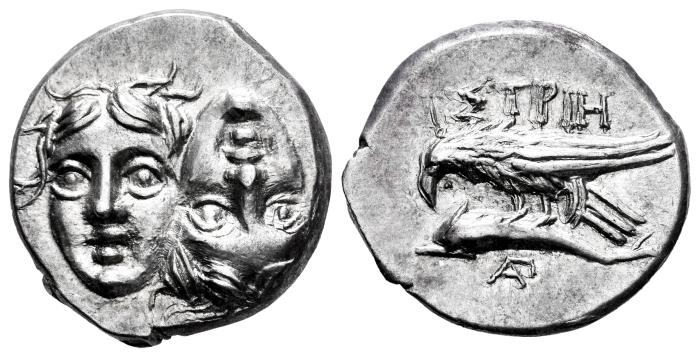
Moesia. Istros. Drachm. 313-280 BC. (Dima-p. 25, 1-4). (SNG BM Black Sea-249). (Hgc-3, 1802). Anv.: Two facing male heads side by side, one upright and the other inverted. Rev.: IΣTPIH. Sea eagle standing left on dolphin; below dolphin, monogram of ΑΠ. . 5,59 g.
Lovely specimen with fantastics portraits. Light toning with original luster. Well-centered, sharp and boldly defined strike. Rare in this grade. AU/XF. Est...400,00.
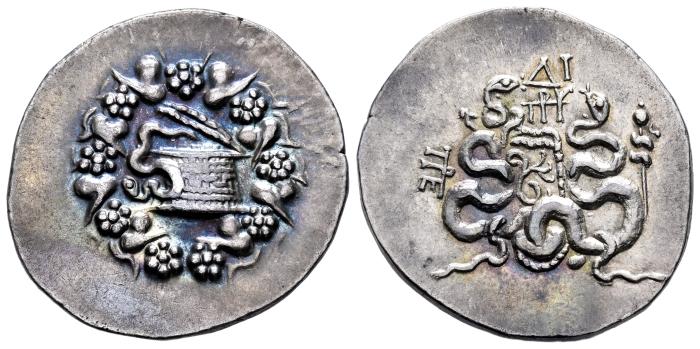
Mysia. Pergamon. Cistophorus. 166-67 BC. (Kleiner-12). (Sng Paris-1734). Anv.: Cista mystica from which snake coils; around, ivy wreath with fruits. Rev.: Two snakes coiled around a bow case; between the snake heads, ΔI above monogram; to left, monogram of ΠΕΡΓ; to right, thyrsos entwined by a serpent. . 12,53 g.
A beautiful specimen, featuring a perfectly centered strike and a delicate patina that creates a lovely contrast with bluish-toned highlights. Almost XF/XF. Est...500,00.
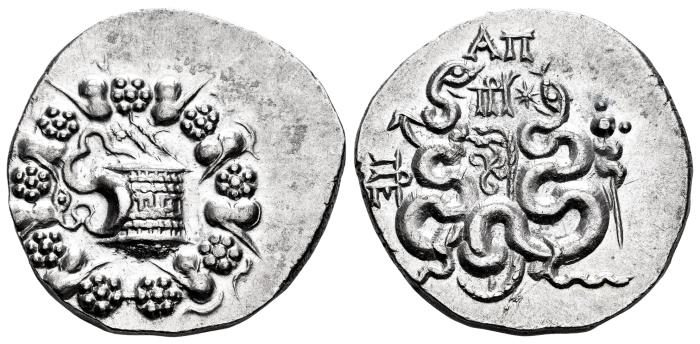
Mysia. Pergamon. Cistophorus. 166-67 BC. (Kleiner-25). (Sng Paris-1726/7). Anv.: Cista mystica from which snake coils; around, ivy wreath with fruits. Rev.: Two snakes coiled around a bow case; between the snake heads, AΠ above prytaneis monogram and star; to left, monogram of ΠΕΡΓ; to right, serpent-entwined thyrsos. . 12,03 g. A beautiful specimen featuring a strong, very sharp strike and retaining much of its original luster. Scarce in this state of preservation. Almost MS. Est...600,00.
Ex Lanz, 1998
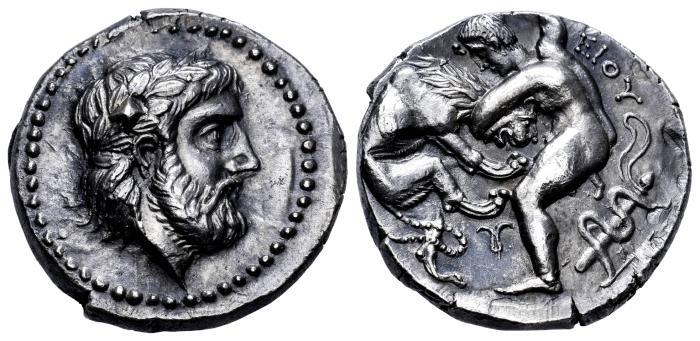
Kings of Paeonia. Lykkeios. Tetradrachm. 359-335 BC. Astibos or Damastion. (Paeonian Hoard-63 var.). (Sng Ans-1019 var.). Anv.: Laureate head of Zeus to right. Rev.: (ΛYKK)-EIOY Herakles standing left, strangling the Nemean lion; to right, bow and quiver; to left of Herakles' leg, Y.. . 12,14 g.
Magnificent specimen of exceptionally fine style, with engraving of clear classical influence and sharply defined reliefs. Perfectly centered strike, with soft cabinet toning that enhances the details and provides an attractive contrast.
Ex Numismatik Lanz 86 (18/05/1998).
The Nemean Lion features in the first of the Twelve Labors of Hercules. According to Greek mythology, this fearsome beast, whose skin was impervious to weapons, terrorized the inhabitants of Nemea.
After discovering that his weapons were ineffective, Hercules managed to corner the lion in its lair and strangle it with his bare hands. He then used the animal's own claws to remove its skin, which became one of his most distinctive attributes, together with his club.
This episode, widely depicted in classical art, symbolizes the triumph of the hero's strength and ingenuity over the forces of nature. Mint state. Est...3000,00.
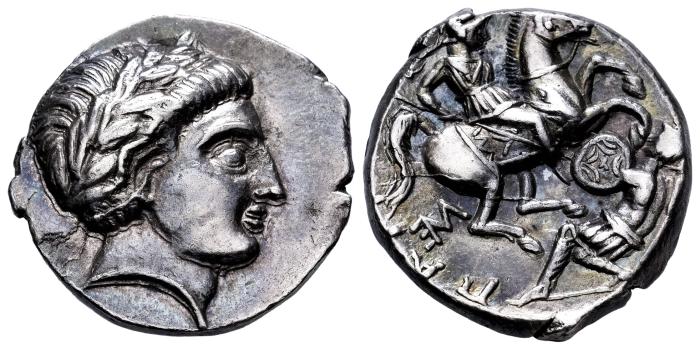
Kings of Paeonia. Patraos. Tetradrachm. 335-315 BC. Astibos or Damastion. (Paeonian Hoard-400). (Peykov-E2140). (SNG Ans-1031). Anv.: Laureate head of Apollo to right. Rev.: ΠΑΤΡΑΟ-Υ Paeonian horseman, wearing crested helmet and full armor, galloping to right and spearing fallen enemy, who defends himself with a spear in his right hand and a shield on his left arm; below the horse's tail, monogram of ƎM; all within shallow round incuse. . 12,51 g.
Boldly struck, very well-centered, with remarkable detail. Attractive toning with subtle bluish highlights. Nice specimen. XF/AU. Est...700,00.
Ex CNG, 1998
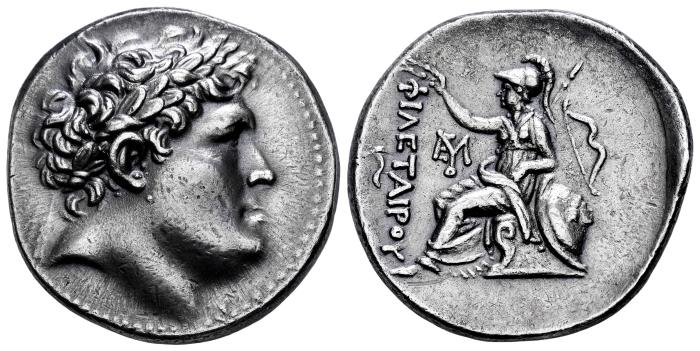
Kingdom of Pergamum. Attalos I. Tetradrachm. 241-235 BC. Mysia. (Sng Cop-339). (Westermark-Group VI, 95A). (SNG Paris-1622). Anv.: Laureate head of Philetaerus right. Rev.: ΦΙΛΕΤΑΙΡΟΥ, Athena enthroned left, crowning royal name with right hand and resting left elbow on round shield propped against throne, transverse spear in background, cornucopiae in outer left field, EYMENOY monogram in inner left field, bow in outer right field. . 16,95 g.
Nice strike with light toning. Very attractive. Rare.
Ex Classical Numismatic Group 45 (18/03/1998), lot 402. XF/Almost XF. Est...1000,00.
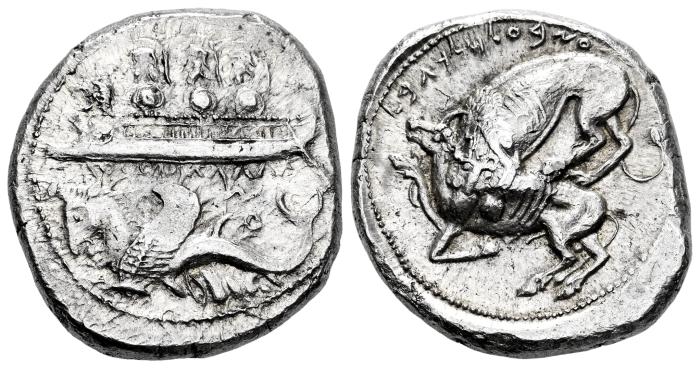
Phoenicia. Byblos. Shekel. 400-376 BC. Ozbaal (Uzzibaal). (E&E-Group IV.2.1.c, 403-471 (O12/R)). (Sng Cop-132). (Hgc-10, 133). Anv.: Galley, with prow terminating in lion's head, on waves to left, carrying three hoplites, each holding shield; below, `Z (in Phoenician script) and hippocamp to left, above murex shell. Rev.: Lion attacking bull to left; 'ZB'L MLK GBL (in Phoenician script) above. . 13,19 g.
Attractive specimen with lustrous surfaces. Slightly irregular flan with minor areas of weak strike. Small knock on the lion's head. Rare. Almost XF/XF. Est...2000,00.
Ex CNG, 1999
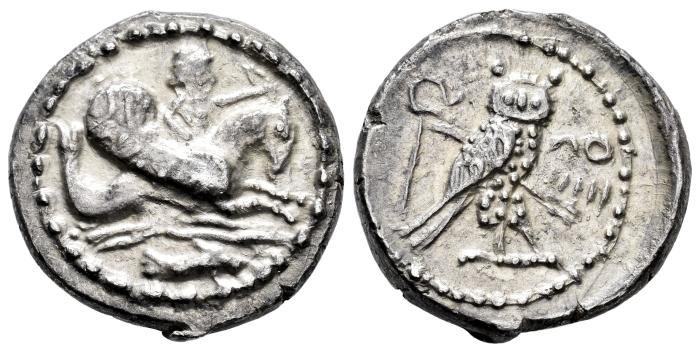
Phoenicia. 'Ozmilk (Azemilkos). Shekel. RY 15 = 335/4 BC. Tyre. (Bmc-40). (DCA-918). (E&E-T Group II.2.1.26). Anv.: Deity, holding reins and bow, riding hippocamp to right above two lines of waves; dolphin to right below. Rev.: Owl standing to right, head facing, with crook and flail in background; in right field, - O and II III (date) in Phoenician. . 8,50 g.
Very well-centered, with light toning and original luster.
Ex Classical Numismatic Group 49 (14/03/1999), lot 606. Almost XF/XF. Est...700,00.
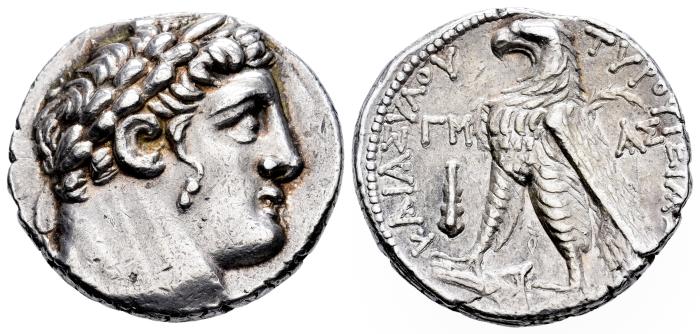
Ex Lanz, 1990
Phoenicia. Tyre. Shekel. CY 43 = 84/3 BC. (Hgc-10, 357). (DCA-921). Anv.: Laureate bust of Melkart right, lion skin around neck. Rev.: TVPOV IEPAΣ KAI AΣVΛOV. Eagle standing left on prow; palm frond behind; to left, ΓM (date) above club; AΣ to right, Phoenician letter between legs. . 12,44 g.
Boldly struck in high relief. Subtle iridescent toning gently outlines the bust on the obverse, adding depth and beauty to the specimen. Rare, especially in this grade.
Ex Numismatik Lanz (12/11/1990)
The Tyrian shekel is particularly notable for its close association with first-century Judea. Its high silver purity and consistent weight led to its acceptance for the payment of the Jerusalem Temple tax. These coins are also traditionally linked to the narrative of the Passion, as the Gospels record that Judas Iscariot received thirty pieces of silver in exchange for handing over Jesus. Although the biblical text does not explicitly identify these coins as Tyrian shekels, this is the identification traditionally proposed by numismatists. XF/Almost XF. Est...2000,00.
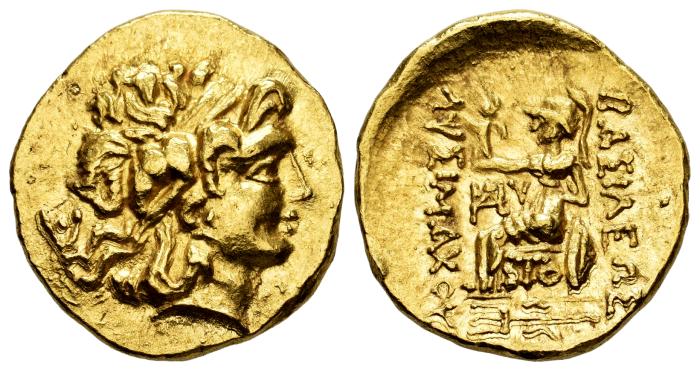
Kings of Pontos. Mithradates VI Eupator. Stater. 88-86 BC. Tomis. First Mithradatic War issue, in the name and types of Lysimachos of Thrace. (Callataÿ-p. 141, D1/-). (AMNG-I 2477). (Sng Cop-1090). Anv.: Diademed head of Alexander the Great to right, with horn of Ammon over his ear. Rev.: ΒΑΣΙΛΕΩΣ - ΛΥΣΙΜΑΧΟΥ Athena seated left, holding Nike, crowning the king's name, in her right hand and leaning with her left arm on shield; behind, transverse spear; in inner left field, monogram of HΔ and Y; on throne, TO; in exergue, ornate trident left. . 8,38 g.
Full luster and lovely color. Strong strike, slightly off-center on the reverse. AU. Est...3000,00.
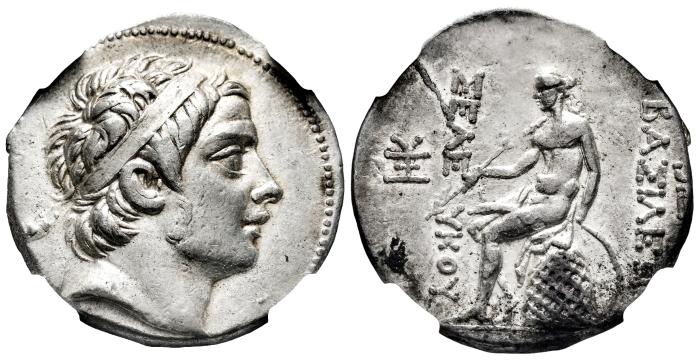
NGC - Ch XF 5/5, 3/5
Seleukid Kingdom. Seleukos III Soter (Keraunos). Tetradrachm. 226-223 BC. Antioch on the Orontes. (Le Rider-Antioche 31/79 (Obv. A3)). (WSM-1029). (SC-921.1). Anv.: Diademed head of Seleukos III to right. Rev.: ΒΑΛΣΙΛΕΩΣ - ΣΕΛΕΥΚΟΥ. Apollo seated left on omphalos, holding arrow in his right hand and resting his left on grounded bow; to outer left and right, monograms. .
Slabbed by NGC as Ch XF, Strike 5/5, Surface 3/5.
Ex Classical Numismatic Group E563 (05/06/2024), lot 280. Est...500,00.
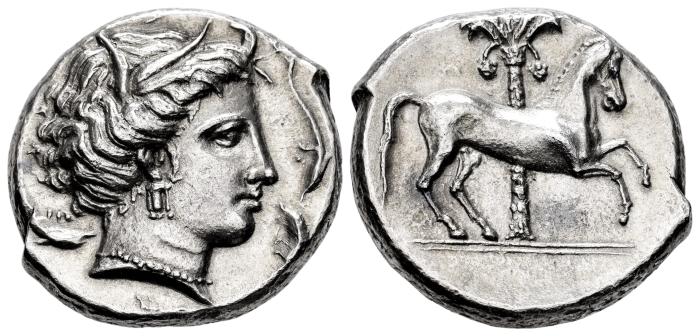
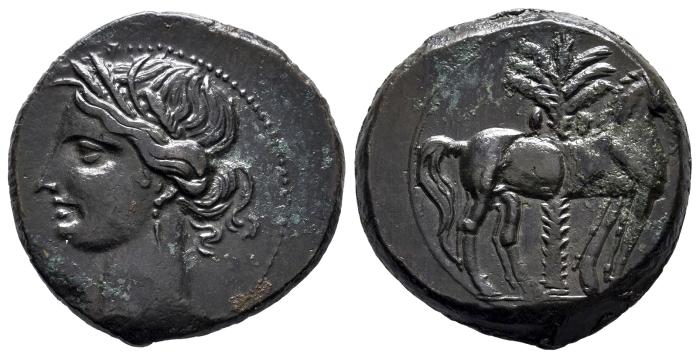
Sicily. Entella. Tetradrachm. 345/38-320/15 BC. (Jenkins-Punic, 132 (O44/R119)). (Sng Cop-82). (SNG Lockett-1038). Anv.: Head of Tanit-Persephone to right, wearing wreath of grain leaves, triple-pendant earring and pearl necklace; around, four dolphins. Rev.: Horse prancing right in front of palm tree with two date clusters. . 16,90 g.
Very well-struck specimen of fine style. Light toning. Attractive. AU. Est...4000,00.
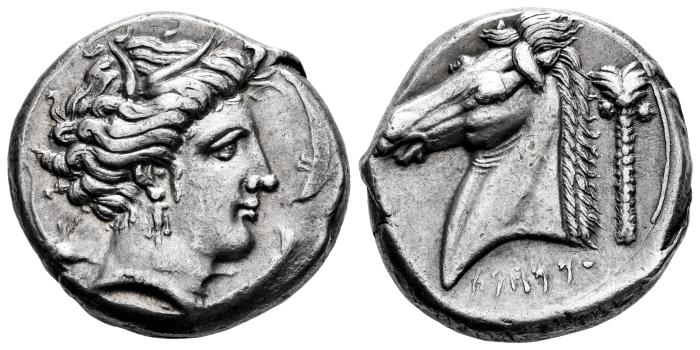
Ex Lanz, 2003
Sicily. Entella. Tetradrachm. 320/15-300 BC. (Jenkins-Punic, 178 (O51/R158)). (Müller-II/15 p.75). Anv.: Head of Tanit-Persephone to right, wearing wreath of grain leaves, triple-pendant earring and pearl necklace; around, three dolphins. Rev.: (š'mmhnt = 'People of the Camp' in Punic) Head of a horse to left; behind, palm tree with two date clusters. . 17,20 g.
Nice style and very rare.
Ex Numismatik Lanz 123 (30/05/2005);
Ex Numismatik Lanz 117, (24/11/2003). XF/Almost XF. Est...2000,00.
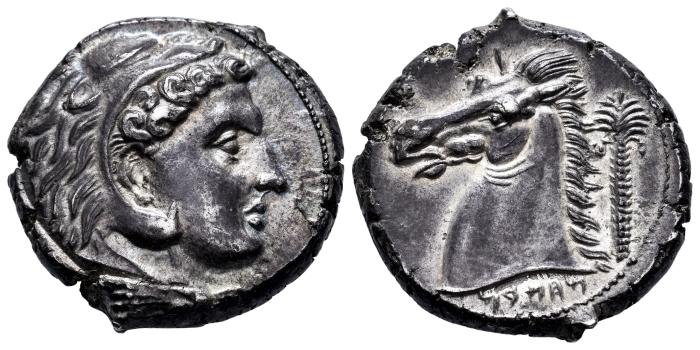
Fine style
Sicily. Entella. Tetradrachm. 300-289 BC. (Jenkins-Punic, 394 (O120/R322)). (Dewing-983). (Hgc-2, 295). Anv.: Head of Herakles to right, wearing lion skin headdress. Rev.: (MHSBM in Punic) Head of a horse to left; behind, palm tree with two date clusters. . 17,12 g. Lovely specimen of exceptionally fine style, with elegant dark toning, underlying original luster and subtle bluish hues on the obverse. Rare, especially in this grade.
Entella, located in the western interior of Sicily, was an ancient city of Elymian origin that held a strategic position in the heart of the island. Throughout the 4th and 3rd centuries BC, it was caught up in the ongoing struggles for control over Sicily, a theater of conflict involving Greeks, Carthaginians, and local populations. This situation made Entella a key point of contact among the various cultures vying for hegemony on the island.
Its coinage reflects this complex political and cultural reality. The tetradrachm presented here displays a horse's head facing left on the reverse, accompanied by a palm tree, iconographic elements rooted in a distinctively Sicilian tradition yet bearing significant connections to the Punic world. The choice of these motifs highlights the cultural influences that converged at Entella and serves as fascinating evidence of the diversity and richness of Sicilian coinage during this turbulent period.. AU/Almost MS. Est...2500,00.
Ex Lanz, 2005
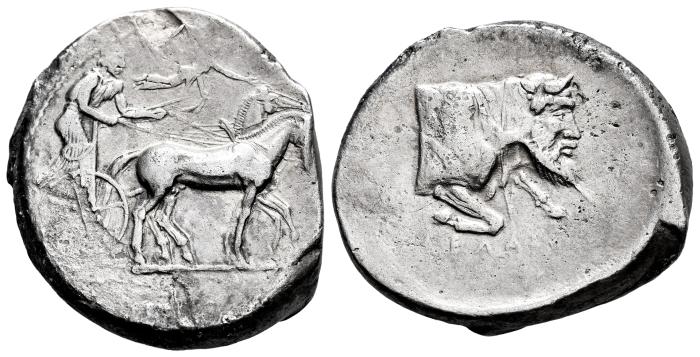
Sicily. Gela. Tetradrachm. 480-470 BC. (Jenkins-364). Anv.: Charioteer, holding kentron and reins, driving slow quadriga to right; Nike above, flying to right, crowning horses with wreath. Rev.: Forepart of man-headed bull to right; CEΛAΣ below. . 16,37 g.
Extremely rare. We have traced only one other specimen on ACSearch, offered at auction on several occasions over the past two decades. The present specimen displays light oxidation on the obverse.
Ex Numismatik Lanz 125 (28/11/2005), lot 80. Choice VF. Est...2000,00.
Ex Ars Classica, 1990
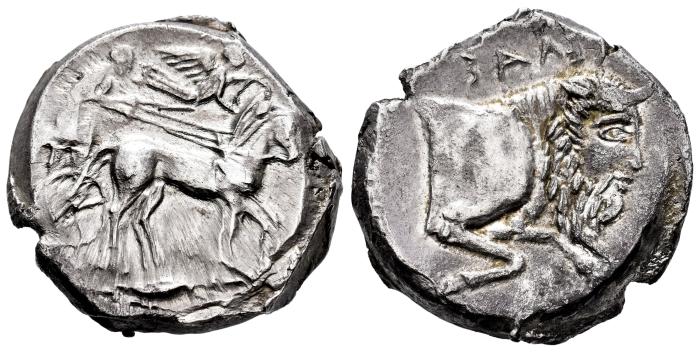
Sicily. Gela. Tetradrachm. 440-430 BC. (Jenkins-Gela , group V, 384.7 (O78/R158)). (Sng Ans-74). (McClean-2238). Anv.: Charioteer, holding kentron in left hand and reins in both, driving slow quadriga right; above, Nike flying right, crowning horses with open wreath held in both hands. Rev.: Forepart of man-headed bull right; retrograde ΓEΛAΣ above. . 17,28 g.
Very attractive for this issue and perfectly centered. Bold strike with all details sharply defined. Light toning with traces of luster. Rare in this grade and with an interesting pedigree.
Ex Numismatica Ars Classica 25 (25/06/2003), lot 71;
Ex Numismatica Ars Classica 2 (21/02/1990), lot 56. Almost XF/XF. Est...3000,00.
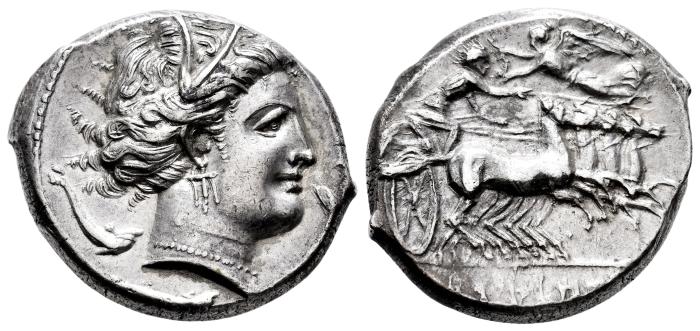
Ex CNG, 1998
Sicily. Lilybaion (as ‘Cape of Melkart’). Tetradrachm. 330-305 BC. (Jenkins-Punic, 47 (O16/R36)). (Jameson-598). (SNG Ans-731). Anv.: (RŠMLQRT in Punic) Charioteer driving quadriga galloping to right, holding kentron in his right hand and reins in his left; above, Nike flying left, crowning the charioteer with a wreath. Rev.: Head of Tanit-Persephone to right, wearing wreath of grain leaves, triple-pendant earring and pearl necklace; around, four dolphins. . 16,91 g.
Light toning with original luster. Lovely portrait of excellent style. Slightly off-center strike.
Ex Classical Numismatic Group 45 (18/03/1998), lot 147. Almost XF/XF. Est...2000,00.
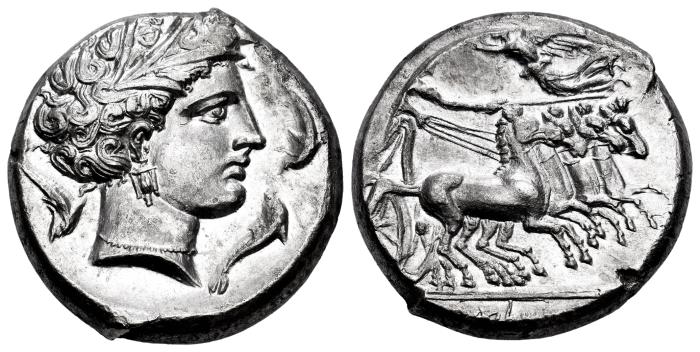
Ex Triton VII, 2004
Sicily. Lilybaion (as ‘Cape of Melkart’). Tetradrachm. 330-305 BC. (Jenkins-I 37 (O14/R28)). (SNG Lloyd-1604). (Jameson-597, same dies). Anv.: (RŠMLQRT in Punic) Charioteer driving quadriga galloping to right, holding kentron in his right hand and reins in his left; above, Nike flying left, crowning the charioteer with a wreath. Rev.: Head of Tanit-Persephone to right, wearing wreath of grain leaves, triple-pendant earring and pearl necklace; around, three dolphins. . 16,67 g.
Superb specimen of excellent style, with virtually pristine surfaces and full original luster. The engraver's exceptional skill is evident in the precision of the details, giving the piece extraordinary eye appeal. A coin of outstanding artistic quality, particularly desirable to the most discerning collectors.
Ex Classical Numismatic Group, Triton VII (12/01/2004), lot 123. AU. Est...3500,00.
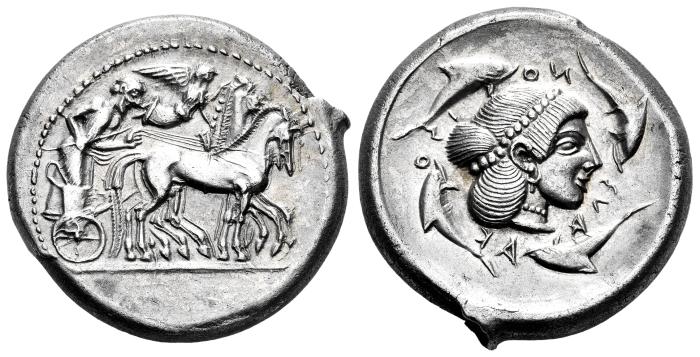
Superb
Sicily. Syracuse. Tetradrachm. 475-470 BC. Deinomenid Tyranny. (Boehringer-296 (V142/R204)). (Sng Ans-97). (Randazzo-462). Anv.: Charioteer driving quadriga walking to right, holding goad in his right hand and reins in his left; above, Nike flying right to crown the horses with a wreath. Rev.: ΣVR-ΑΚ-ΟΣΙ-ΟИ. Diademed head of Arethousa to right, her hair drawn up at the back, wearing single pendant earring and pearl necklace; around, four dolphins swimming right. . 17,25 g.
Magnificent specimen of excellent style, with an exceptionally sharp, perfectly centered strike that allows all the engraved details to be fully appreciated. Soft, attractive toning with subtle underlying original luster that enhances the reliefs and gives the piece extraordinary eye appeal. A truly lovely specimen that will undoubtedly attract the attention of even the most discerning collectors.
A magnificent example of the celebrated coinage of Syracuse, regarded as among the most highly prized issues in ancient Greek numismatics.
Following the victory at Himera in 480 BC, Syracuse established itself as the leading power in Sicily. Under the rule of Hieron I, the city enjoyed a period of great prosperity and prestige, extending its influence throughout the island and southern Italy through alliances and military campaigns.
One of the most significant events of his reign was the Battle of Cumae in 474 BC, when a Syracusan fleet came to the city's aid against the Etruscan threat. The decisive naval victory weakened Etruscan maritime power and greatly enhanced the prestige of Syracuse. To commemorate their triumph, the Syracusans dedicated an Etruscan helmet captured during the battle at the sanctuary of Olympia.
This coin was struck during this period of Syracuse's greatest political and military splendor under the rule of Hieron I. Almost MS/Mint state. Est...9000,00.
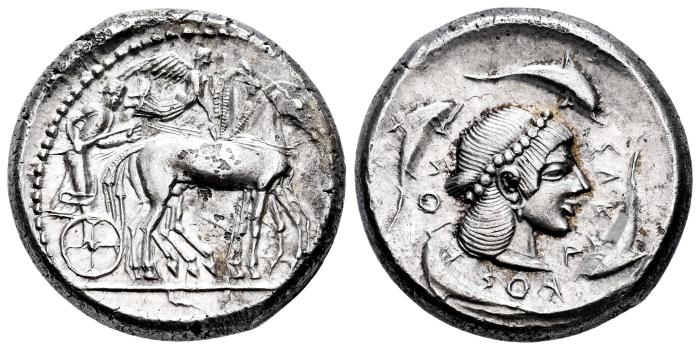
Ex Triton X, 2007
Sicily. Syracuse. Tetradrachm. 475-470 BC. Deinomenid Tyranny. (Boehringer-(V173/R243; unlisted die combination)). (Hgc-2, 1307). (SNG Ans-110, same dies). Anv.: Charioteer, holding kentron in his right hand and reins in his left, driving slow quadriga to right; above, Nike flying right to crown the horses with a wreath. Rev.: ΣVR-Α-ΚΟΣ-ΙΟN Pearl-diademed head of Arethousa to right, her hair drawn up at the back, wearing single pendant earring and plain necklace; around, four dolphins swimming right; all within shallow circular incuse. . 17,13 g.
Lovely specimen with original luster, light oxidation on the obverse and subtle toning that outlines and enhances the bust on the reverse. Area of minor porosity on obverse. Rare in this exceptional grade.
Ex Classical Numismatic Group, Triton X (08/01/2007), lot 89. Almost XF/AU. Est...3000,00.
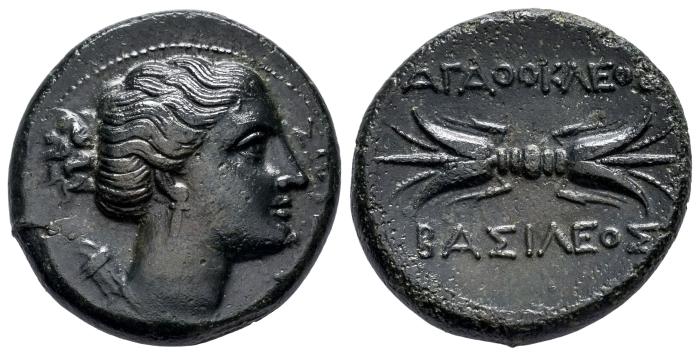
Sicily. Syracuse. AE 22. 304-289 BC. Time of Agathokles. (CNS-138). Anv.: ΣΩT(EIPA). Draped bust of Artemis Soteira to right, quiver over shoulder. Rev.: BAΣIΛEΩΣ - AΓAΘOKΛEOΣ Winged thunderbolt. . 8,29 g. Pleasant dark green patina. Ex Leu Numismatik Web 4 (24/06/2018), lot 75. Choice VF. Est...150,00.
Ex CNG, 2000
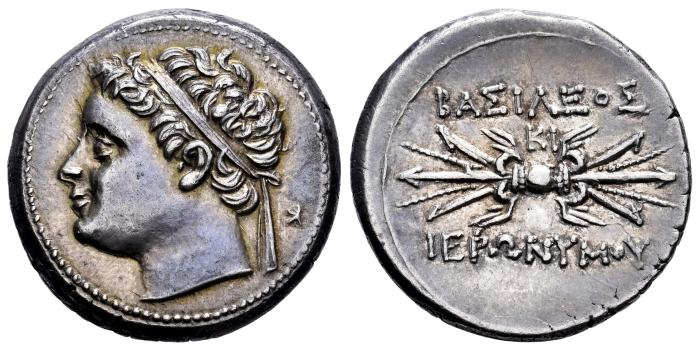
Sicily. Syracuse. 10 Litrai. 215-214 BC. Time of Hieronymos. (Hgc-2, 1567). (Holloway-41m (O21/R33)). (SNG Ans-1029). Anv.: Diademed head of Hieronymos to left; in field to right, ꓘ retrograde. Rev.: BAΣIΛEΩΣ - IEPΩNYMOY. Winged thunderbolt; above, KI. . 8,42 g. A Superb specimen with a magnificent strike and excellent centering. Portrait of exceptionally fine style with sharply defined reliefs. Lovely cabinet toning with subtle golden hues and traces of luster. Very rare in this extraordinary grade.
Ex Classical Numismatic Group 53 (15/03/2000), lot 139
Hieronymus ascended the throne of Syracuse during a particularly turbulent period of the Second Punic War. Just a year earlier, a Roman consular army comprising eight legions and allied troops had been annihilated at the Battle of Cannae, sending shockwaves through the Roman power structure and altering the political balance in Sicily.
His grandfather, Hiero II, had maintained a steadfast alliance with Rome for decades; however, a faction favoring Carthage—the city's traditional enemy—was gaining strength in Syracuse. The young Hieronymus, weak-willed and easily influenced, succumbed to pressure from his uncles—proponents of the Carthaginian alliance—and decided to break with Rome. This momentous decision would ultimately plunge Syracuse into one of the most dramatic episodes of its history. AU. Est...2500,00.
Ex CNG, 1997
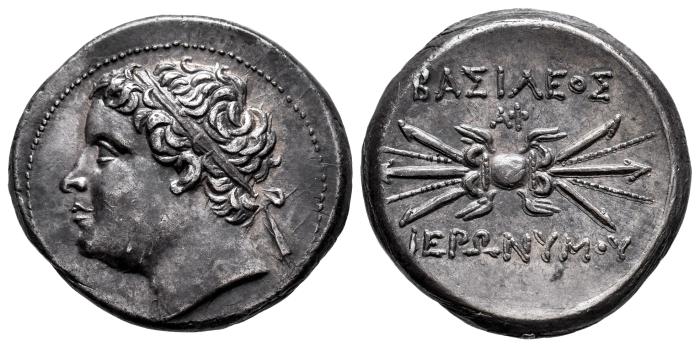
Sicily. Syracuse. 10 Litrai. 215-214 BC. Time of Hieronymos. (Hgc-2, 1567). (Holloway-27). (SNG Ans-1034). Anv.: Diademed head of Hieronymos to left. Rev.: BAΣIΛEΩΣ - IEPΩNYMOY. Winged thunderbolt; above, ΑΦ. . 8,45 g.
Magnificent specimen with uniform, attractive toning and subtle iridescent hues. Very well-centered and rare in this grade.
Ex Classical Numismatic Group 43 (24/09/1997), lot 195. AU. Est...2000,00.
Ex CNG, 1997
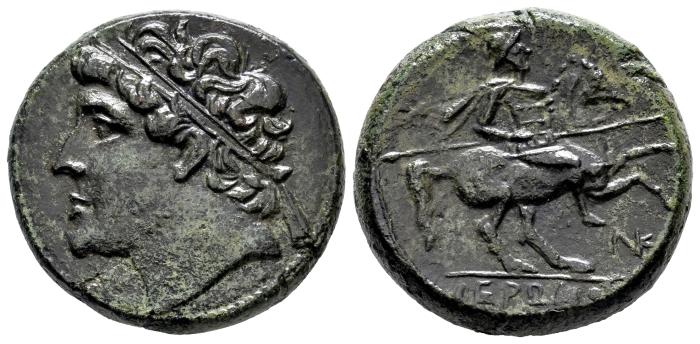
Sicily. Syracuse. AE 26. 230-215 BC. Time of Hieron II. (CNS-195 var.). (Hgc-2, 1548 var.). Anv.: Diademed head to left. Rev.: Armoured cavalryman on horseback and holding spear, riding to right; NK below, IΕΡΩΝΟΣ in exergue. . 16,84 g.
Ex Classical Numismatic Group 43 (24/09/1997), lot 187. Almost XF. Est...200,00.
X
Confirm your maximum bid
Conecting
 English
 Español




 0
 0