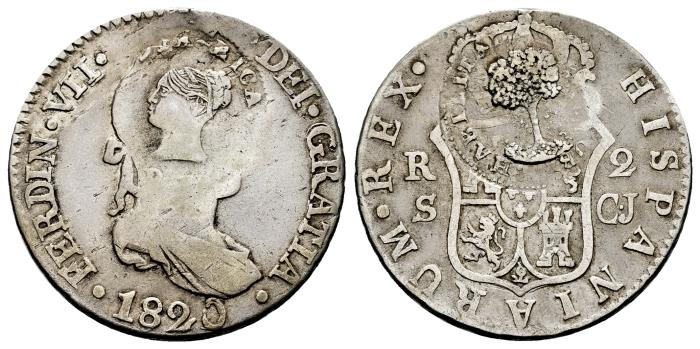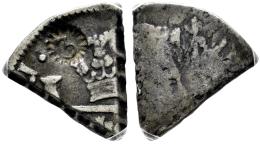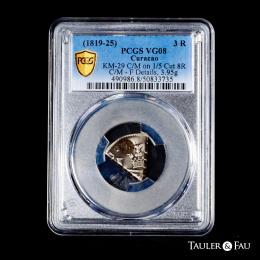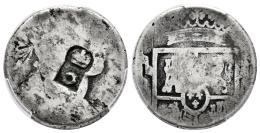
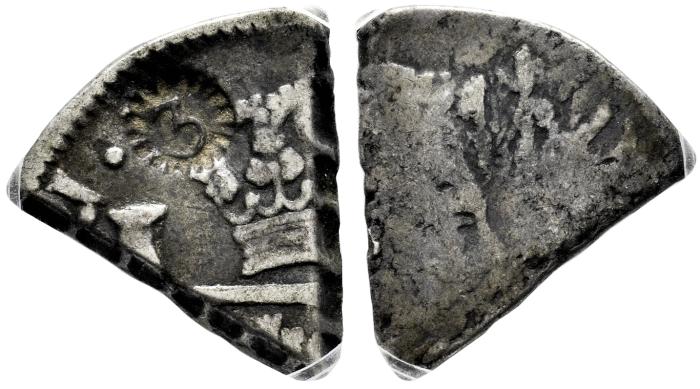
Curaçao - VG 08
Curaçao. 3 reaals (18 stuivers). ND (1819-1825). (Km-29). . 3,95 g. Associated with local ordinance of 13 July 1818. Stylized "3" within dentilated circulate indent. Applied to the reverse of a 1/5 cut 8 reales of Ferdinand VII, minted in Mexico between 1812 and 1821. This is a much more precise attribution than is typically possible on this type, owing to the partial assayer's initial and the face of the monarch on the opposing side. Slabbed by PCGS as VG 08 - C/M on 1/5 Cut 8R, F Details. According to a governmental report dated 20th December 1825, after the government ceased buying Dollars to make small change in 3 and 5 parts, cutting was open to anyone and became a general practice with pieces being readily accepted. The report also goes on to confirm their private token status and that they were permitted for general circulation by convention. Est...300,00.
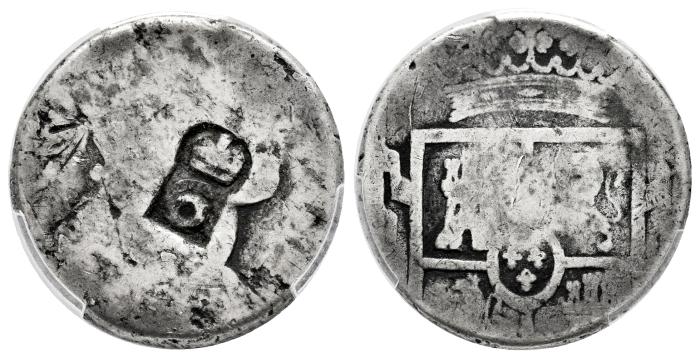
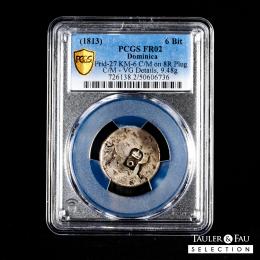
Dominica - FR 02
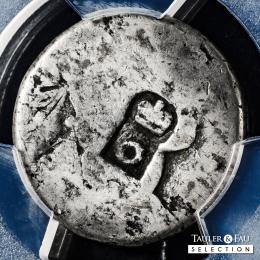
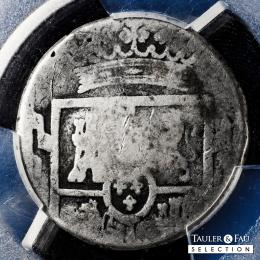
Dominica. George III (1760-1820). 6 Bitts (4 shillings 6 Pence). ND (1813). (Km-6). (Pridmore-27). . 9,48 g. Clear countermark with a crowned “6” applied on the central circular segment of a Lima 8 Reales of Ferdinand VII, by decree of the local authorities dated August 21, 1813. Well-defined countermark over the characteristic indigenous bust type of the Lima series, struck only between 1809 and 1811. In general, the mint is difficult to determine on this issue, since the area where the countermark was applied is usually very worn and many specimens show some degree of damage. Apart from identifying the king represented, there are hardly any other distinctive features. In this case, by the style of the bust, the coin can be attributed without any doubt to the Lima mint. An interesting issue from the West Indies. Extremely rare. Slabbed by PCGS as FR02 - C/M on 8R Plug VG Details. Est...1000,00.
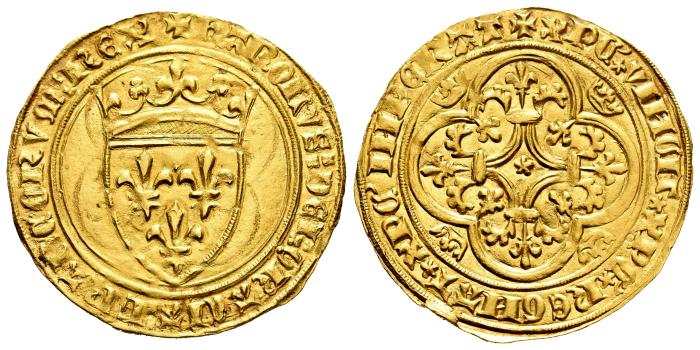
France. Charles VI le fou (1380-1422). Ecu d´or à la couronne. ND (1389-1394). Paris. 3rd emission. (Duplessy-369B). (Fried-291). Anv.: + KAROLVSx DEIx GRACIAx FRANCORVMx REX.. Rev.: + XPC* VINCIT* XPC* REGNAT* XPC* IMPERAT. . 3,91 g. Nice color and luster. Lovely specimen. AU/Almost MS. Est...1500,00.
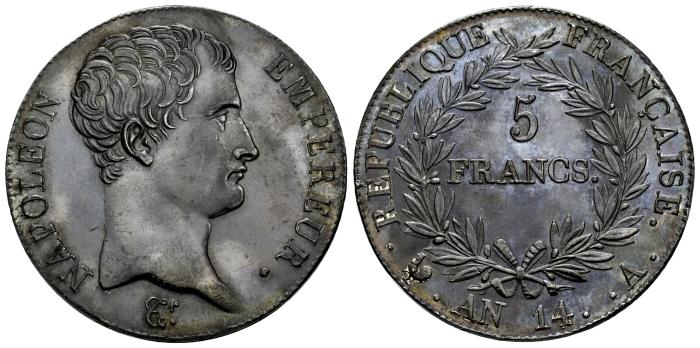
Lovely patina
France. Napoleon Bonaparte. 5 francs. AN 14. Paris. A. (Km-662.1). (Gad-580). (Dav-83). . 24,97 g. Attractive dark patina with delicate mauve and golden highlights, enhancing its eye appeal. Retains original luster. Only a minor surface abrasion at the center of the obverse. Super and rare in this state of preservation. Mint state. Est...1800,00.
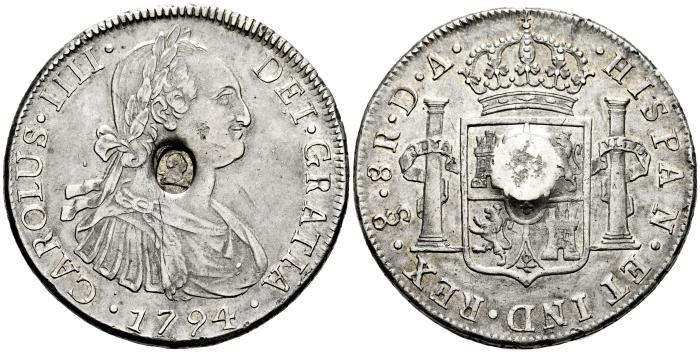
Oval C/S over Santiago 8R
Great Britain. George III. 1 dollar. (Km-634). (S-6765A). . Bank of England oval counterstamp with the face of George III for circulation of 5 shillings, made in 1797 on a 8 reales minted in 1794 for Mexico during the reign of Charles IV. Lovely and delicate cabinet tone with underlying luster with excellent eye appeal. The countermark is deeply and sharply defined. Very rare on a Santiago host, and even more so in this high grade. Slabbed by NGC as AU Details, Obv. spot removed. 1794DA C/S: UNC Strong. This counterstamp brought a latent discontent among the English people, given that one real of a 8 stamped was equivalent to a crown minus three pennies, namely 4 shillings and 9 pennies (1 crown = 5 shillings; 1 shilling = 12 pennies). It generated some humorous phrases such as "The Bank (of England) in order to make its money pass, stamped the head of a fool on the neck of an ass". Est...4000,00.
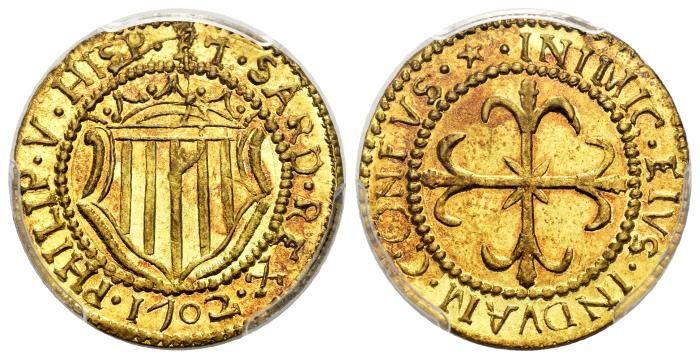
PCGS - MS 63 Top Pop!!
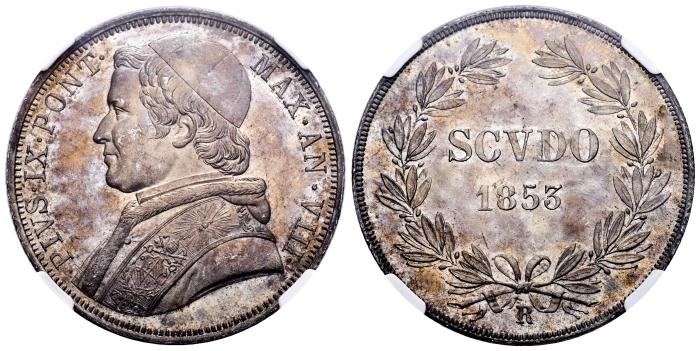
Italy. Scudo d'oro. 1702. Cagliari. (Vti-49). (MIR-93/2). (Fried-145). . Sharp and attractive packed with original luster. Toned with ruddy orange hues illuminated from beneath. No signs of wear or handling. Sharply struck with great eye appeal. Slabbed by PCGS as MS 63. (Top Pop), the finest known in the PCGS census. Est...2500,00.
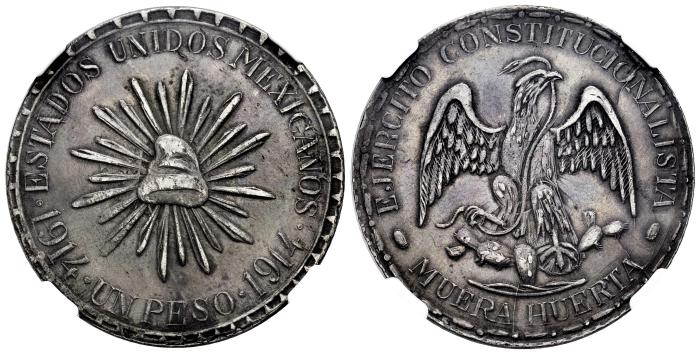
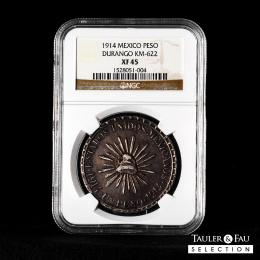
"Muera Huerta" - XF 45
Mexico. 1 peso. 1914. Durango. Cuéncame. "Muera Huerta". (Km-622). . One of the most popular issues of the Mexican Revolutionary period. Variety with dotted-and-dashed border on obverse and beaded edge on reverse. Soft luster throughout, with dark patina and light signs of circulation. A perfect specimen for the collector seeking a representative example of this highly sought-after type. Slabbed by NGC as XF 45. Est...3000,00.
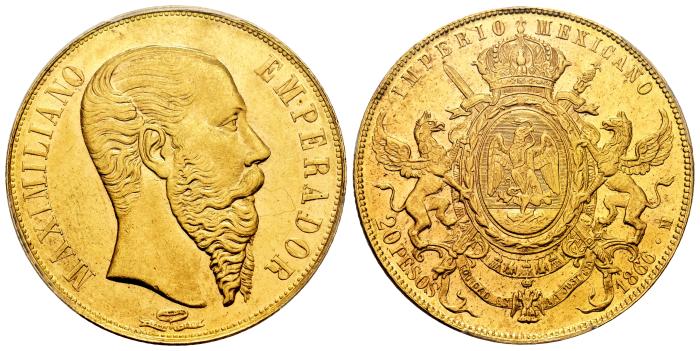
PCGS - MS 62
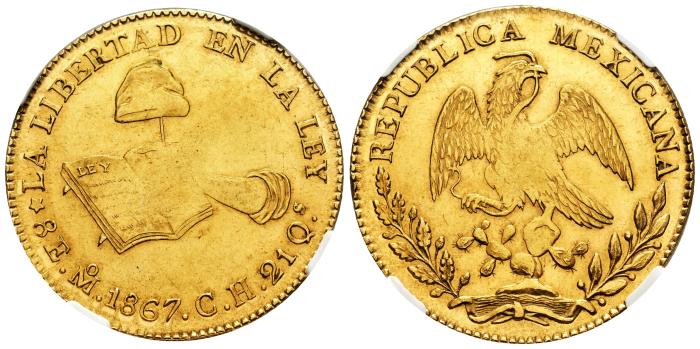
Mexico. Maximiliano. 20 pesos. 1866. Mexico. (Km-389). (Fried-62). . The highest denomination and the only gold issue struck during the Second Empire.
Magnificent specimen with intense color and excellent luster. Lovely eye appeal. Undoubtedly a highly appreciated and sought-after issue in any grade, and one that will be greatly valued by collectors of this period.
Very rare, especially in this condition. Slabbed by PCGS as MS 62. Est...15000,00.
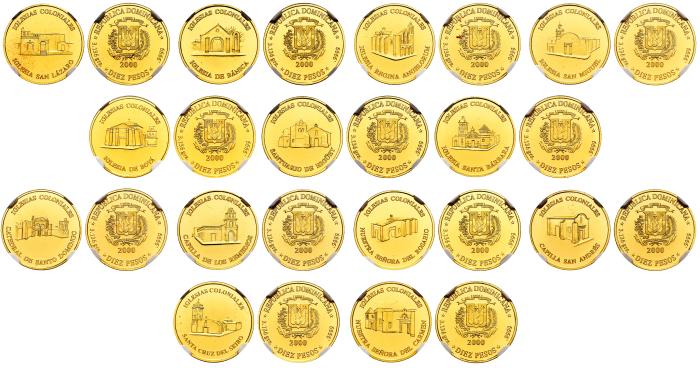
MS Deep Prooflike
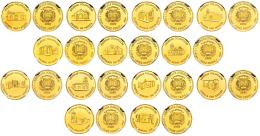
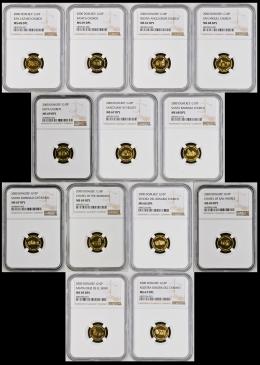
Dominican Republic. Complete set of 13 gold 10 Pesos “Colonial Churches” coins, struck in the year 2000, all certified by NGC with exceptional Deep Prooflike grades. The set includes the following pieces: Nuestra Señora del Carmen (MS 67, KM113), Santa Cruz de El Seibo (MS 69, KM116), Chapel of San Andrés (MS 69, KM122), Nuestra Señora del Rosario (MS 66, KM114), Chapel of Los Remedios (MS 69, KM121), Cathedral of Santo Domingo (MS 67, KM101, listed for silver), Santa Bárbara (MS 68, KM115), Sanctuary of Higüey (MS 67, KM120), Boya Church (MS 69, KM112), San Miguel (MS 68, KM118), Regina Angelorum (MS 67, KM93), Banica (MS 69, KM111), and San Lázaro (MS 68, KM95). A set of extraordinary quality and visual appeal, representing one of the most highly regarded series in modern Dominican numismatics. Est...5000,00.
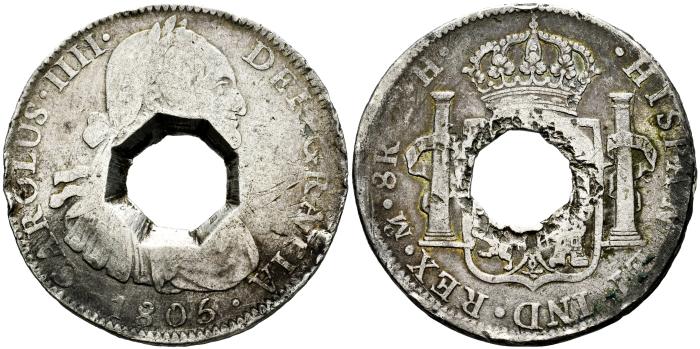
Trinidad - 9 Bitts
Trinidad. 9 Bitts (9 Shillings) Countermark, ND (1811). Authorized on June 11 of that year, consisting of a central octagonal cutout with plain edges pierced from the obverse of an 1805-TH Mexico 8 Reales. (Km-A14.1); (Pridmore-3). The quantity of dollars to be cut was limited to no more than 25,000 pieces. The extracted central plugs were assigned a value of 1 Bitt (1 Shilling) and stamped with the letter “T”, identifying the colony. These central plugs were officially ordered withdrawn from circulation on December 1, 1823.
A proclamation issued by Sir Ralph Woodford on 14 September 1814 specified that the pierced dollars were to continue circulating by tale at 9 Shillings, until such time as they were ordered to pass by weight. It is known that some examples continued to circulate as late as 1860, at a value of 3 Shillings 9 Pence (90 Cents).
This piece exhibits moderate, honest circulation wear, entirely typical of an issue that remained in use for decades, with some rim knocks and light encrustation on the reverse. An appealing historical artifact, and scarce in any state of preservation. Ag. 24,07 g. Almost VF. Est...1500,00.
X
Confirm your maximum bid
Conecting
 English
 Español





 5
5
 3
3