English
 Español
X
Historical Background
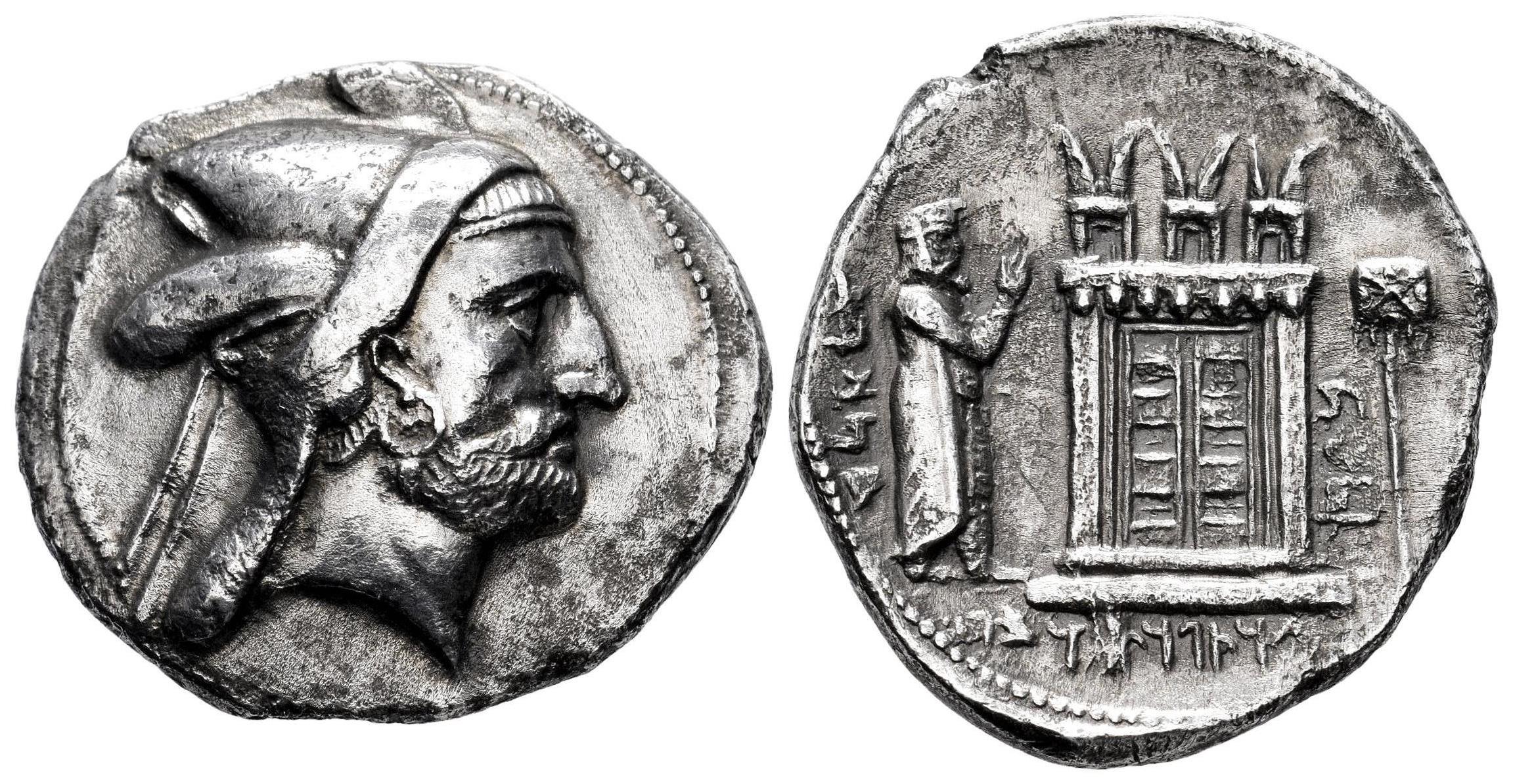
Kings of Persis. Bagadat (Bayadad). Tetradrachm. Early 3rd century BC. Istakhr (Persepolis). (Alram-515). (Sunrise-560 var.). (Van't Haaff-515/519c). Anv.: Head right, with short beard, moustache, and earring, wearing kyrbasia with flaps tied behind. Rev.: Aramaic legend: (br) bgwr[t] (= "(son of) Baywār[d]") downward to right, bgdt prtrk' zy (= "Baydād frataraka of") in exergue, 'lhw' (= "the gods") upward to left, fire temple of Ahura-Mazda; to left, Bagadat standing right; standard to right. . 15,45 g.
Excellent style and well-centered for this issue. Slight smoothing in the fields, possibly resulting from an earlier removal of oxidation, which does not detract from its eye appeal. Extremely rare.
Bagadat (or Bayadad) was a frataraka, governor of Persis under Seleucid rule, who exercised his authority from Istakhr, in the heart of ancient Achaemenid Persia. He represents one of the earliest manifestations of the resurgence of native Persian power following the conquests of Alexander the Great.
His coinage reflects the survival of Persian political and religious traditions. On the reverse, he is depicted before a fire altar, a symbol associated with Zoroastrianism and the Achaemenid heritage. In the early 3rd century BC, possibly taking advantage of the instability following the death of Seleucus I, Bagadat may have gained increasing autonomy from Seleucid rule, making his coins an important testament to the revival of Persian political identity. Almost XF. Est...4000,00.
Auction Lots
Confirm your maximum bid
Confirm your maximum bid
Loading…
Conecting
Are you sure you want to buy the lot?
X
Confirm your maximum bid
Conecting